
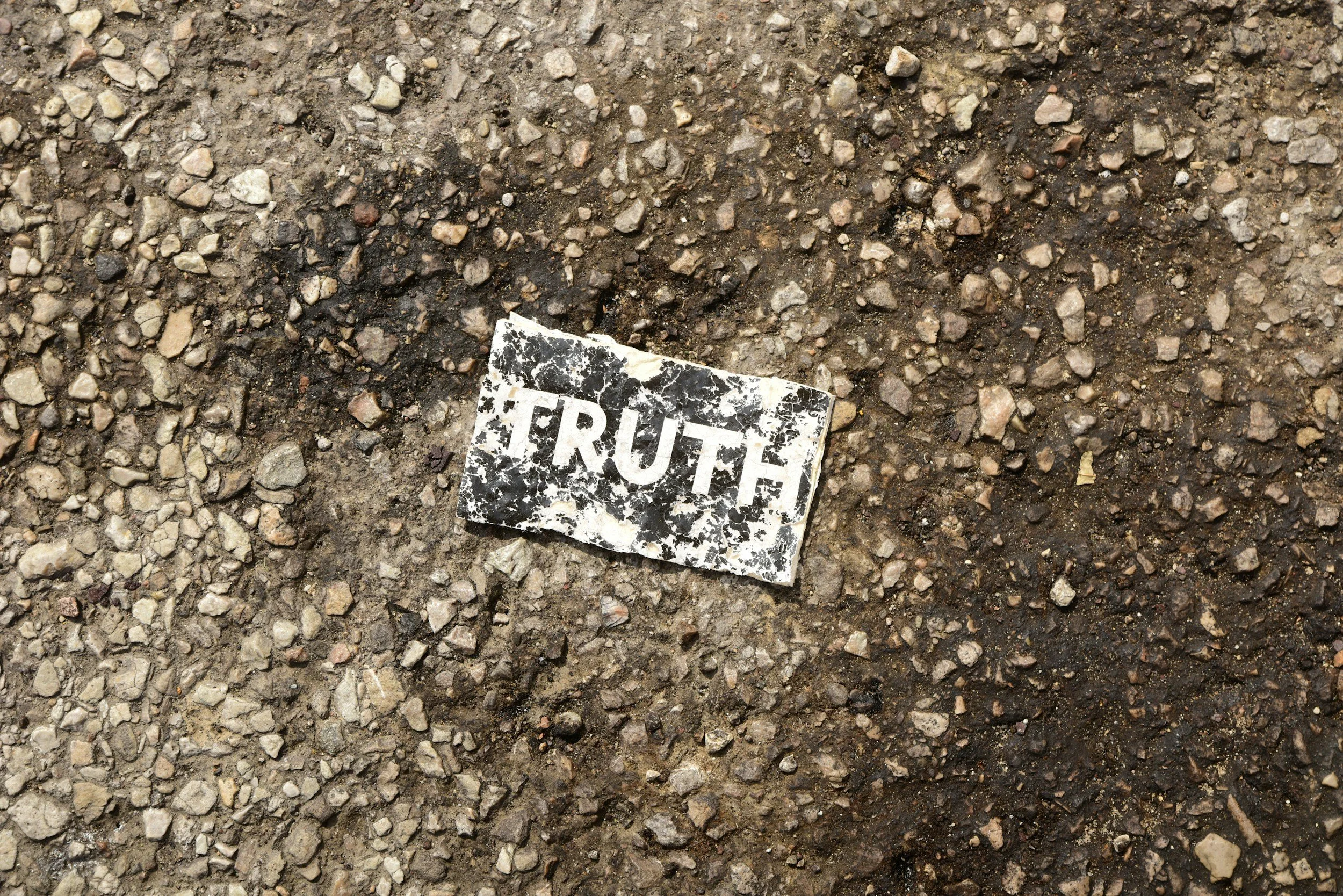
Despite everything we are seeing in the news, the concept of truth (and “the truth”) is central to critical thinking, to liberal learning, and to democratic citizenship. And despite all my past efforts to suggest how complicated the concept of truth is, sometimes it isn’t. Some things just are, or are not, the case, and it degrades the very idea of truth to debate them. Who won the 2020 election, for example.
I stand by my arguments (which reach back several books) that truth is a tricky thing in general. We all have a tiny (one-divided-by-infinity) and imperfect grasp of what it’s convenient to call “reality.” Yet it remains convenient to call it “reality,” which is to say, a way that things are or were that we can agree on.
The actress Daryl Hannah stirred up these thoughts with a recent opinion piece in The New York Times about her inaccurate portrayal in the TV series “Love Story” about JFK, Jr. Why do I know she’s right in contesting her portrayal? I’m inclined to say I just do; but a producer she quotes in her article confirms that accuracy – to the extent a portrayal of anyone can ever be “accurate” – was not their chief concern. Rather, it helped to portray her negatively to tell the story they wanted to tell, as opposed to the truth. It’s just one grotesque example of truth compromised by commercialism. And why we need the concept of truth even if we can never catch the critter and put it in a cage.
Accuracy is an important auxiliary concept, a subdivision of truth: it means adherence to a known standard or archetype, textual or otherwise. Textual accuracy is pretty straightforward, dare I say “objective”; other kinds, such as dramatic reproductions (on stage or audiovisual) are at best approximations of what actually happened and how people spoke and behaved.
Strictly speaking, no docudrama is ever accurate, by definition, although some may be more accurate than others. That said, I’m not condemning the dramatization of history. Overall, we probably learn far more from them than we lose through distortion. But there are many glaring exceptions. Media literacy demands that we discount such dramatizations as rough approximations or worse.
I tried to make this point years ago in The Sound Bite Society when I talked about “the indelibility effect.” It was purely speculative, not based on empirical evidence, but I think it’s sufficiently plausible as to verge on common sense. What I meant by “indelibility” is that, when we see a reproduction of a historical event (say, an account of the Lincoln assassination) our natural psychological and epistemic tendency is to accept it as accurate, even when we know we are seeing a dramatization of history. Our brains sort it as truth even when our minds say: “Wait a minute. Someone made this up based on a few known facts.” Even the most sophisticated viewers, I believe, tend to do this to some extent, to believe their eyes, even while knowing that they’re seeing actors and hearing lines written in the present day.
A recent portrayal of the career of President James A. Garfield (“Death by Lightning,” a four-part miniseries on Netflix) is a case in point. I felt that learned a lot from it, knowing full well that Garfield didn’t look exactly like the actor or speak most of the lines the actor spoke. I bought into it as a depiction of the man and his times. Moreover, I think we have no choice: we must willingly or unconsciously succumb to the indelibility effect to invest in such infotainment at all. The critical energy it takes to separate known past history from current re-enactment is simply too exhausting and would drain such shows of any value. But don’t suppose that “Gone with the Wind” is anything like an accurate portrayal of slavery in the South.
Ms. Hannah writes: “Many people believe what they see on TV and don’t distinguish between dramatization and documented fact – and the impact is not abstract. In the digital era, entertainment often becomes collective memory. Real names are not fictional tools. They belong to real lives.” My indelibility thesis is just a more abstract version of that statement. And it’s one that extends it to all viewers, not just the more gullible or uncritical ones. I wish Ms. Hannah well should she seek recompense for the injury done to her. And I congratulate her on using her experience to point out the difference between well-intentioned approximations of history/reality/truth and fundamentally dishonest ones. We need more viewers, and actors, like her.