
As a self-styled independent scholar, I do a fair amount of reading (despite being a slow, plodding reader). It’s mostly a gleaning process, and the result is a vague balance of what one consciously learns or remembers and what somehow gets absorbed unconsciously into one’s frameworks and factual understandings. It’s the rare book or essay that is memorable as a reading experience.
In recent posts I’ve mentioned two essays that did that for me. “Ur-Fascism” by Umberto Eco, and “Aristotle on Justice: A Paradigm of Philosophy” by Renford Bambrough have profoundly affected my thinking. (Arguably, Eco’s essay did more to reinforce or harden my thinking than to mold it). So, too, Virginia Woolf’s marvelous short essay (from The Death of the Moth and Other Essays) titled “Words Fail Me.”
It’s difficult to recall the last book I could say that about, although there have been many over the years. But one recent volume that is very good, ambitious, and imperfect, has been transformative in a different way, morally and politically rather than intellectually. I’m talking about Katherine DuVal’s Native Nations, which won the 2025 Pulitzer Prize for History, the prestigious Bancroft Prize in American History, and other accolades. It left me spent, saddened, and more alienated than ever from the violence and injustice that have been the great shaping forces of the American past – and present.
That’s saying a lot. Having lost considerable faith in America over the past ten years (I hope my children aren’t reading this, because I don’t want them to know how I feel) DuVal’s account of Native American history has driven me further from America’s moral center, such as it is.
I already had a fair notion of how badly the First Nations were treated by white settlers and the U.S. Government. But DuVal’s sprawling, yet highly selective, account of that history pounds the points home: the racism and near-annihilation; the forced relocations to reservations, followed by the attempted destruction of native cultures, including by forbidding customs and practices and the abduction and forced re-education of native children in infamous boarding schools. (The “1923” series produced by Kevin Costner, one of the prequels to “Yellowstone,” deals graphically with one such school in one of its plot threads. It doesn’t mince images or storylines.) The themes are clear: oppression, extermination, and the forced assimilation of indigenous peoples whose tribal societies were too many and diverse (and often too warring amongst themselves) to permit any unified opposition to the white conquest.
What’s unclear is exactly how DuVal chose her focal points in Native Nations. She all but ignores colonial New England – and astonishingly, makes no mention of the bloodiest war fought between whites and natives in North America, King Philip’s War (1675-78). She ignores other corners of the Continent, including Florida and the Pacific Northwest. Fair enough: literally and figuratively, it’s simply too much ground to cover. What she does write about tells a story of unremitting violence and subjugation.
I’m tempted to use the word “tragedy,” and it was and is a terrible tragedy for Native Americans in the ordinary sense of that word. But the Greek idea of tragedy conveys a kind of inevitability, a moral permission slip based on the impossibility of making better choices. That was not the case in America. What happened here was a catastrophe based on moral idiocy at best and downright brutality at worst, mostly the latter, based on a categorical sense that the Indians were subhuman and their cultures worthless. But who were the true savages?
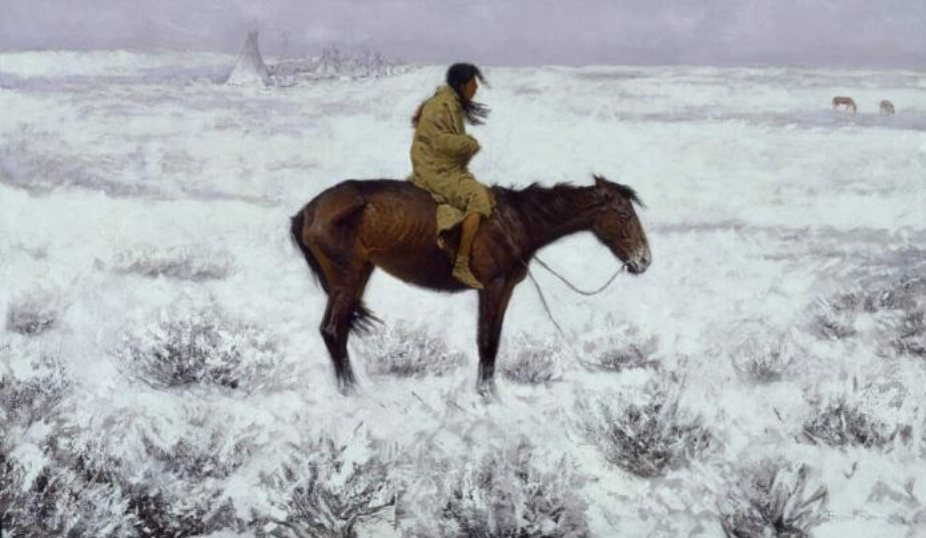
“The Herd Boy” by Frederic Remington, ca. 1905 (Museum of Fine Arts Houston)
The far right will of course contest this history, and their nativist bigotry will always be part of the American experience. But we can hope that their numbers and voices eventually dwindle, like those of the defenders and practitioners of slavery. Whatever can or cannot be done to compensate their descendants, the immense suffering of Native Americans, African Americans, Chinese immigrant laborers, and others must be remembered with dignity, solemnity and sadness. It’s what patriots do.