
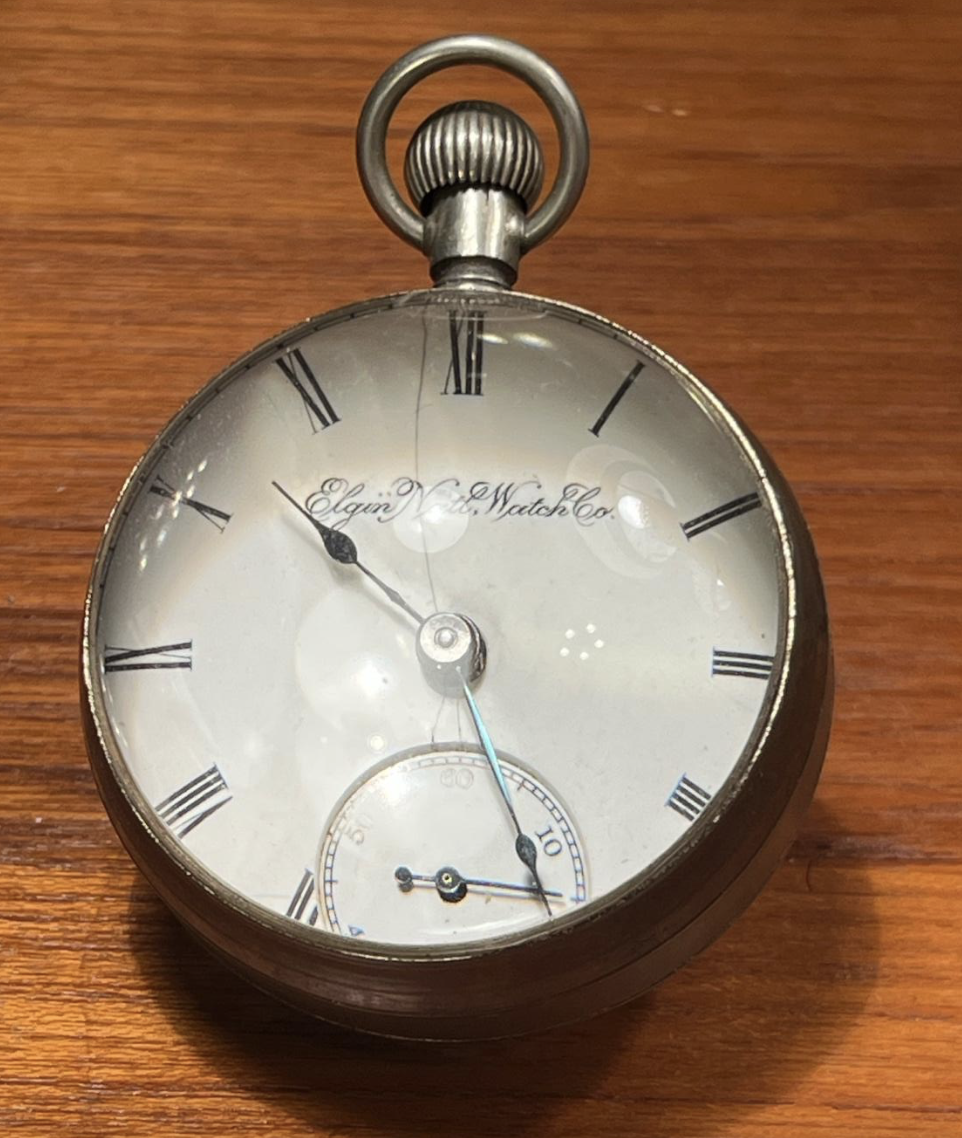
How should we think about time? Are there any parameters that we could identify as “critical temporal thinking”? I’m talking here about human time as opposed to spacetime, which is the real astrophysical thing from Einstein onward. We can let physicists deal with that one.
Human time is what we’re stuck in, and yet we strain to define it – perhaps because, even more than space, it seems limitless, featureless, and (although artificially divisible into hours, days, etc.) inherently mystifying. It’s almost as if our minds were designed to fail to comprehend it. And whatever science tells us about spacetime (for example, that its curvature explains the phenomenon we call “gravity”), it doesn’t affect how we deal with time as humans, how we live or feel or think, or what we collectively decide to call “real.” Spacetime is awe-inspiring and confusing but not a big deal in daily life. Gravity sort of takes care of itself.
No discipline that I’m aware of – not even history – teaches us how to think about time per se, as opposed to the order in which things occur (chronology) and what causes what. Physicists can’t agree on whether or not what we call “time” exists, which passes the ball on to philosophers, who, like the rest of us, seldom understand what the physicists are saying. No discipline teaches us a whole lot about causality either, although history, philosophy, and the sciences give it a try. This tells us something about how we think and how we structure knowledge. Yet questions of causality pervade the liberal arts.
So where to begin? Let’s start with the semi-obvious: the past is closed and in some sense fixed, even as our views about it change. Things can potentially happen (future tense) in multiple ways, but they happen (present tense) in one way, and they happened (past tense) in one way. (The physicists might argue, but they’re talking about a different level of reality.) That’s part of the conundrum of causality: our seeming free agency always leads to one state-of-the-world outcome, or set of outcomes, at least in this universe. The future seems open and fluid, until it is no longer the future.
On the scale of an individual human life, the future shrinks and the past gets longer; on the larger natural scale, not so much. And the recent past is less opaque to us than the near future. Although we know, if we think about it, that the future can’t differ radically from the present – there must be discernible causal pathways getting us from here to there – we still have trouble envisioning where we (self, or world) will be in, say, three years. I know my knees will get weaker, and my grandchildren will grow, but that’s about it. We know that shocks like 9/11, Trumpism, or Covid-19 will occur, but that doesn’t suddenly change everything. It doesn’t turn the sky green or lead to incoherence.
The past, as I said, can be artificially divided into moments, hours, days, years, generations, eras. Some of these are fixed quantities, others vague. Decades and centuries are often misleading, as they acquire identities (like the Fifties, the Sixties) that don’t perfectly match the fixed time spans. The “real” 19th century probably lasted from about 1815 to 1914. But (like “Monday,” or “2024”) most such artifices are more useful than not. And like all abstractions, we can qualify them.
Indeed, one way to think critically about time is just this: to qualify such artificial boundaries – and to know when to stop. We can’t discard those conventions without crippling our language as a medium of thought. A minute may be a minute, but a generation is vaguer and more complicated.
We can also think critically about time in terms of the twin dilemmas of causality and causation (without which we wouldn’t have, or need, a concept of time). A reminder to readers: I distinguish causality – the metaphysical question of whether or how much free will we enjoy, as opposed to being stuck in a deterministic web of causes beyond our control – from causation, which is the problem of ascertaining what has in fact happened, in history, in our lives, in the final act of Hamlet, and so forth.
Causality is an insoluble but manageable conundrum. Causation is manageable too, but in a different sense. We do our best to identify, order and weight “events” and find links between them. The process is never perfect, and it gets messier the further back in time we look; but it’s all we’ve got.
Another axiom for critical temporal thinking, I’d suggest, is that causality and causation must be considered both in tandem and separately. Together, they reflect how the idea of cause-and-effect pervades human life, consciousness, the liberal arts.
Another critical concern is that we experience time as co-extensive with change; without change, there could be no perception of the passage of time, and thus, in effect, no time – and no consciousness. Luckily for us, change happens and we are conscious beings. But time is not co-extensive with any particular type, pace, or degree of change. For example, it’s reasonable to generalize that the world changed more in the 1940s than in the 1930s; or that there was more cultural change in the 1960s than in the 50s. And there was more change in my own life from birth to age five than from age 20 to 25. So, time is experienced as change, but change has its own irregular patterns in time – if such a thing is possible. Like I said: our minds struggle for traction on this topic.
A few more observations and then I’ll stop, because as you can see, time is hard to talk about, and mine is running out. (Time has a funny way of doing that: it runs out, but then automatically replenishes itself without stopping.) One point is that, because we experience time, our psyches inevitably distort it. Some days drag while others fly by. Some ballgames seem longer and others shorter, depending on whether your team is winning, among other things. We are not perfect timekeepers. I enjoy gray and rainy days because, in the absence of ever-changing sunlight, time seems to slow down (but it doesn’t). I focus better when the sun isn’t out.
Moreover, across the span of a lifetime our sense of personal time changes. At twenty, the future looked open and horizonless, which was nice – but did I appreciate it then? Did I even think about it? And would appreciating it have lessened the niceness? At seventy-something, my past is longer and my future shorter, and that makes all the difference. It’s not a bad thing; as the time remaining shrinks, it becomes more precious, and the present means more: the peach I’m eating right now.
In short, across the vast reaches of experience, we need to reckon with our own incapacity to be atomic clocks, i.e., to reckon with time and account for the ways in which we distort it. That reckoning involves an endless and critical, but always imperfect, process of self-correction. Cue the psychologists – or some of them anyway.
Finally, it’s perhaps worth considering why we are more past-focused than future-focused. Obviously, the past has happened and feels definite; we can partially access and explain it by poking around in the detritus, the evidence of what happened, and form ideas about causality and why it happened. This of course depends on what we are trying to explain (the Civil War, or why I burned a chicken in the oven last night) and what evidence remains.
Reconstructing the past fully or with perfect accuracy is not in the cards. Properly speaking, it is metaphysically impossible in the known universe. We don’t have all the evidence, and what we have is indirect, because we can’t relive the past and wouldn’t want to. Cue the pragmatists, because we need to make choices and rank things and people and events in terms of importance. And we don’t have endless time or capacity to look in either direction, past or future.
Still, it seems fair to ask why thinking about the near future, beyond our desk calendars, is so alien to us. The obvious answer is that it’s rife with uncertainty and unpredictability, and forecasting tends to look foolish after time has elapsed. Yet somehow the future always emerges from the present, as the present does from the past, and not from something else. And while it always contains surprises, that’s not all it contains. We aren’t totally blind to what is to come; just legally blind.