
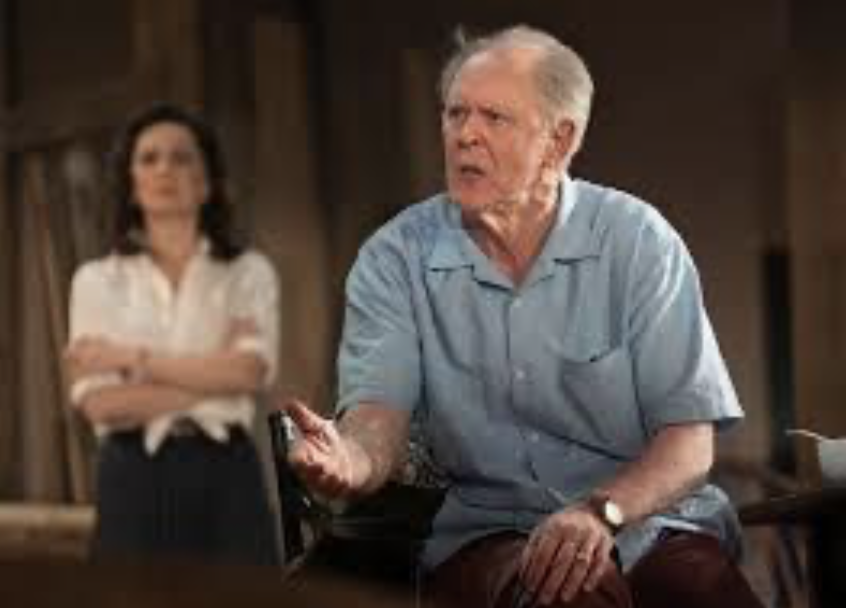
The play “Giant” by Mark Rosenblatt , now running at the Music Box Theater in New York, combines a big-name writer as its subject (Roald Dahl), a weighty topic (antisemitism), and a brilliant star in the leading role (John Lithgow). It’s directed by the great Nicholas Hytner. It can’t miss – and it doesn’t. The man, the topic, and the star turn by Lithgow are all enthralling.
I read some of Roald Dahl’s children’s literature when I was young – most memorably, James and the Giant Peach. As an adult, I was amused by his clever short stories, which are ghoulish and twisted, the twist often coming at the end. But most of all I was moved by his memoirs of World War II and earlier.
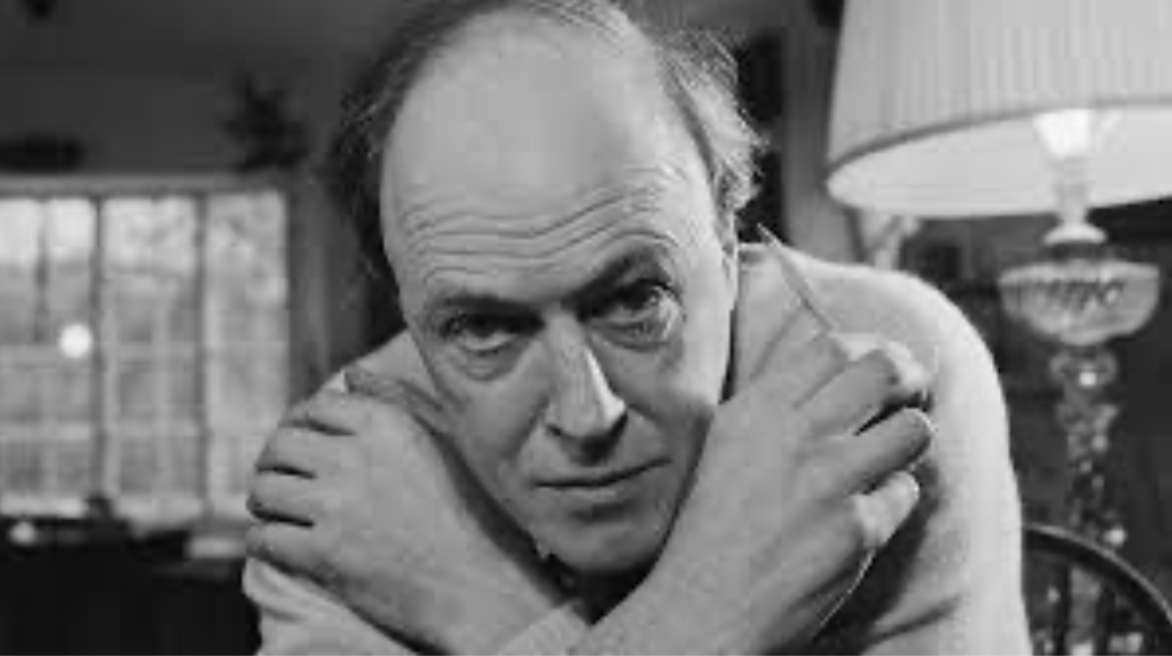
Roald Dahl
Transported by his family from Norway to England as a child, Dahl grew up English, and was working for Shell Oil in Kenya when the war broke out. Without returning home, he trained for just two weeks to become a pilot in the RAF, and served in the Middle East, was badly wounded in Egypt, and was in the last British squadron in the air over Greece. Over to You is a volume of short stories about those times, as are the autobiographical books Boy and Solo: personal accounts of heroism, fear and endurance.
Dahl’s experience in the Middle East imbued him with a sympathy for the Palestinian people. This made him increasingly anti-Israel, and in the early 1980s, when the biographical play “Giant” takes place, he has driven himself to the verge, and arguably beyond the verge, of genuine antisemitism. Many would simply write him off as a Jew-hater; I suspect that self-hatred was the more driving force in his psyche. Not because of his political beliefs, but because he allowed hatred to inflect them.
Nothing of great dramatic consequence occurs in “Giant,” although it catches Dahl at a pivotal moment in his late career and shows him stubbornly unwilling to compromise for his own self-interest. The issue isn’t his anti-Isreal views but his willingness to provoke claims of actual bigotry.
The failure to distinguish between criticism of Israel and antisemitism is itself a moral slur, and “Giant” shows that both sides of this fraught issue are capable of doing just that. But the play also reminds us just how complicated that issue is, however clear we may be in our moral judgments: how subjectively we construe it, and how often we are given to lapses of critical and moral judgment – in Dahl’s case, seemingly willingly and maliciously.
At the pivotal point in “Giant,” he goes over the edge. A perhaps too charitable interpretation of the scene is that his sense of isolation from the pro-Israeli Anglo-American mainstream gives rise to his appalling statements. Whether he genuinely hates some Jews, or all Jews, seems to me less than clear; but then, we all see this issue through our own moral lenses.
What’s striking and indisputable is that this recent play, set in Britain in 1983, addresses questions that have scarcely changed in more than forty years. We are (unfortunately) still debating not just antisemitism and the morality of Israeli state policies, but how or whether the two phenomena are connected.
The main Jewish character in the play is Jessie Stone (played by Romola Garai), a sales and marketing executive for Farrar, Straus and Giroux, Dahl’s American publisher. She gives a strong account of herself, pleading with Dahl to apologize for his offenses (which came in a favorable review that he wrote of an anti-Israeli book), without defending Israel’s 1982 invasion of Lebanon. She, not Dahl, is the moral center of the play.
Roald Dahl’s anger and frustration (and his native cruelty and headstrong need to offend) are the unstoppable forces in “Giant” that lead to the downfall of his reputation. He was a very good writer. But because he was unwilling to clearly state that he wasn’t a bigot, he shrank as a man.