Wovon man nicht sprechen kann, darűber muss man schweigen.
Ludwig Wittgenstein, Tractatus Logico-Philosophicus (1921)
Wittgenstein’s famous aphorism translates as follows: “Whereof one cannot speak, one must remain silent.” Or for those who prefer a less subtle approach: If you can’t say it, shut up. Wittgenstein was talking about philosophy; and it turns out that, contra Wittgenstein, you can still say a lot about philosophy without trespassing beyond coherence. He did so himself, a few decades later. But the idea still has traction, and especially so in the realms of the arts and the spiritual. There are certain things we can’t necessarily agree upon with others; but there are also certain things we just can’t talk about; and things we can only talk about with difficulty.
Talking about art – and especially writing about it, depending on the visual, musical, tactile, or other parameters of the original medium – is one of those hard things. It doesn’t come easily to me. Art by its nature appeals indiscriminately to both our rational and our emotional faculties (and they don’t just co-exist; they are deeply entangled with one another). Creative expression often circumvents language or literal meaning. Paintings are visual, and as much as I love them, I am not a visual person. What I’m groping to say is that certain aspects of aesthetic experience are ineffable; and others are only partly effable. Trying to express them is challenging and can lead to nonsense. What we call “artspeak” is a sad example of that: word salads concocted by people who you would think never had to write a term paper. Wittgenstein, instead of encouraging silence, might have said: Just make sense.
But my point here is not to hold up art historians, critics, or museum professionals to ridicule. It isn’t hard to find nonsense in art magazines or next to paintings on the walls of museums; but for the most part, what art professionals do, what they say and write, is vitally important. If anything, I’m focusing here on my own shortcomings, because unlike most of those writers, I lack the experience or the eye to say clearly and sensibly why I respond to some works of art and not others. That frees me to simply report how I feel, but even that is hard to put in words. In short, I think there’s an epistemic, if not ontological, barrier between language and visual media, and bridging that barrier is possible but challenging, not just because we aren’t all good writers but also because words are not, and cannot be, sounds or pictures. It’s as simple as that (and also more complicated).
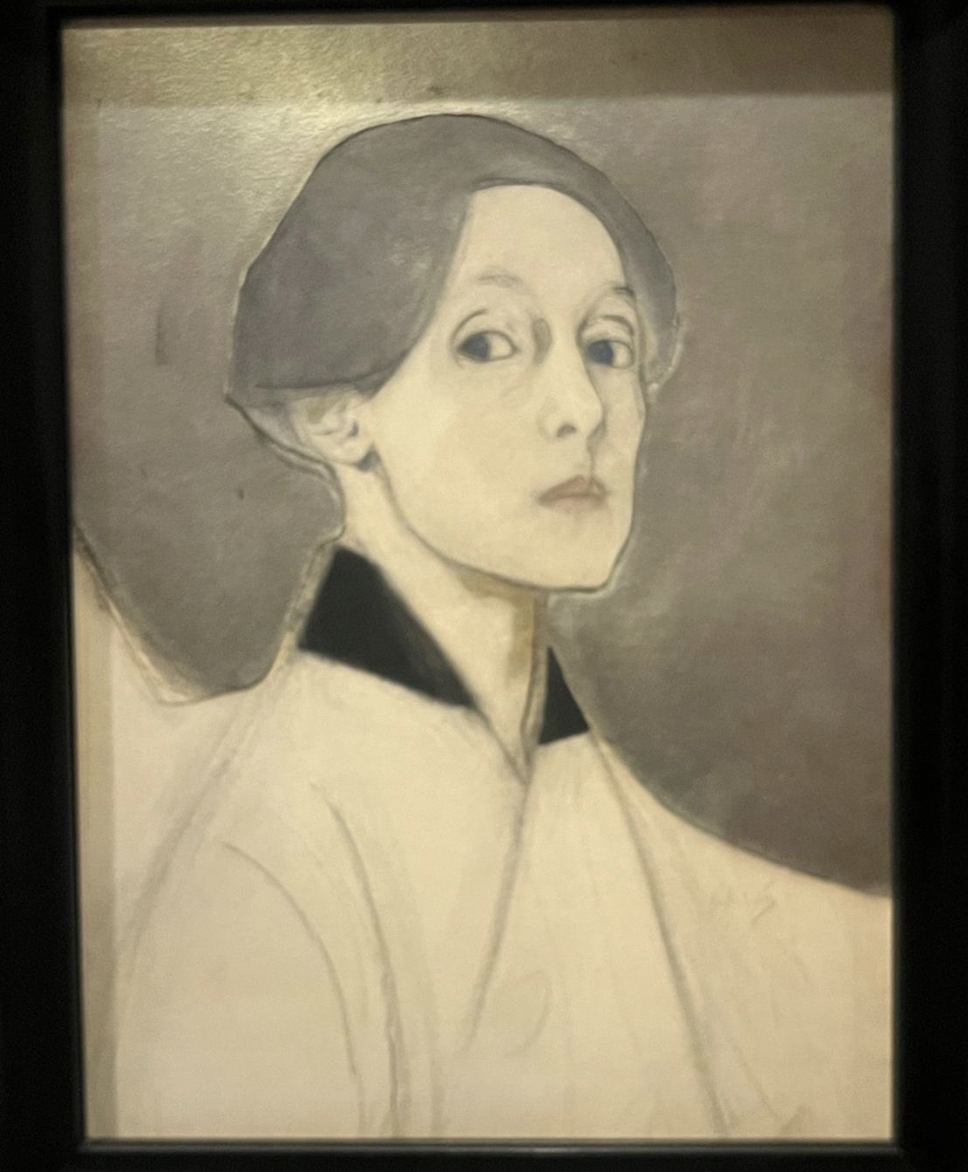
Helene Schjerfbeck, Self-Portrait with Silver Background, 1915
This is a long-winded and pedantic lead-in to my other main point. I recently saw the exhibit of Helene Schjerfbeck’s paintings at the Metropolitan Museum in New York, which ran through April 2026. I had never heard of her until a few weeks earlier; I’m not a connoisseur of art, just a passionate museumgoer. Schjerfbeck (1862-1946) was a Finnish artist of partly Swedish descent who studied art in France and then lived and worked in Finland. And her work is magnificent. It makes me feel good. Or as the song goes in Cole Porter’s hilarious musical “Out of This World”: “I read Schopenhauer last night, and I think Schopenhauer was right.” For me, Schjerfbeck is right.
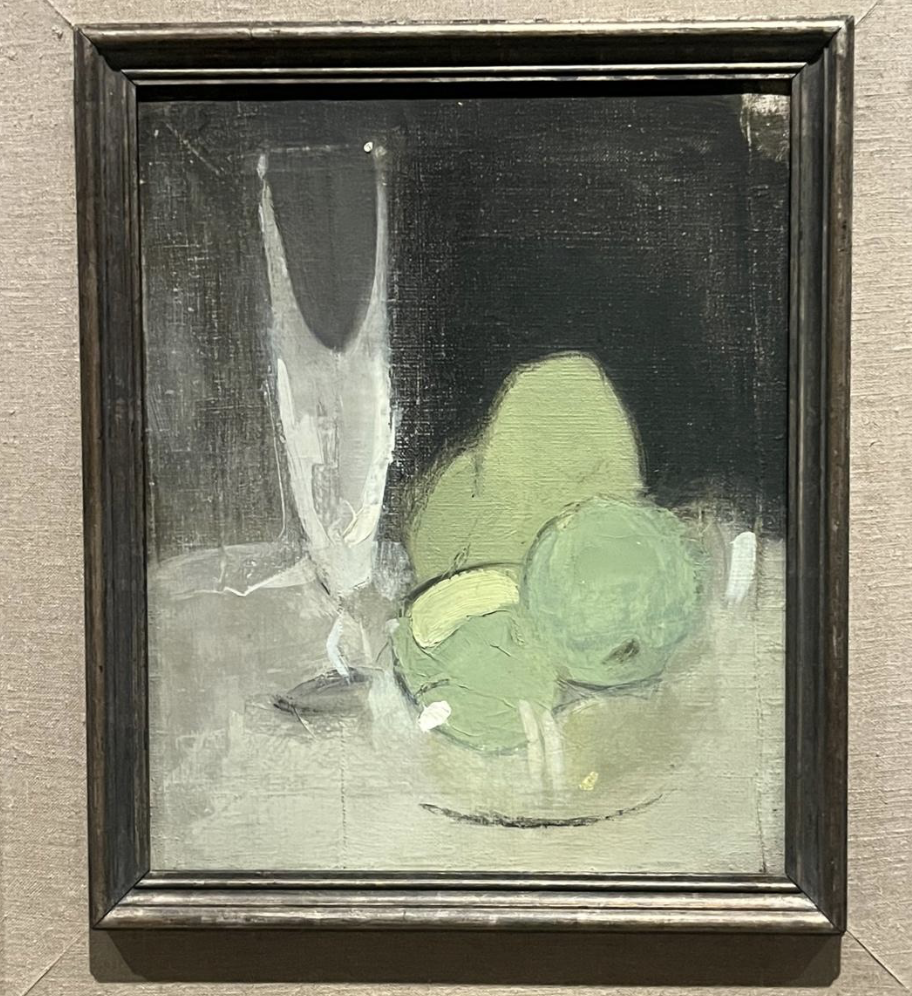
Helene Schjerfbeck, Green Apples and Champagne Glass, 1934
Discovering an artist whom you respond to is exciting in more than one way. There’s the experience itself (whether or not the work is considered to be “beautiful”): the savoring of a particular sensibility, and a sense of connection that is often beyond words. There’s also the thrill of discovery: I didn’t know this existed, and it pleases me, I know not why. I assume it must be mirroring or answering something in myself: a need, a longing, peace, gratitude? In some instances, there may also be an exhilarating feeling of growth: a sense that this artist, at this moment in my life, has shown me something new: a way of seeing, an expanded mental palette, or (most often for me) a pathway into my own imagination.
Maybe it’s laziness that deters me from trying to better understand and describe Schjerfbeck’s works at the Met; or maybe it’s humility, which is always a good excuse to fall back on. I have a penchant for things Nordic, and there’s something uniquely Nordic – dark, dramatic, and beautiful – going on here. In sum, it speaks to me in what almost feels like a private language. By a happy coincidence, right after seeing the exhibit I discovered an excellent feature film about Schjerfbeck titled “Helene” (2020, written and directed by Antii Jokinen), which is streaming on Prime Video.
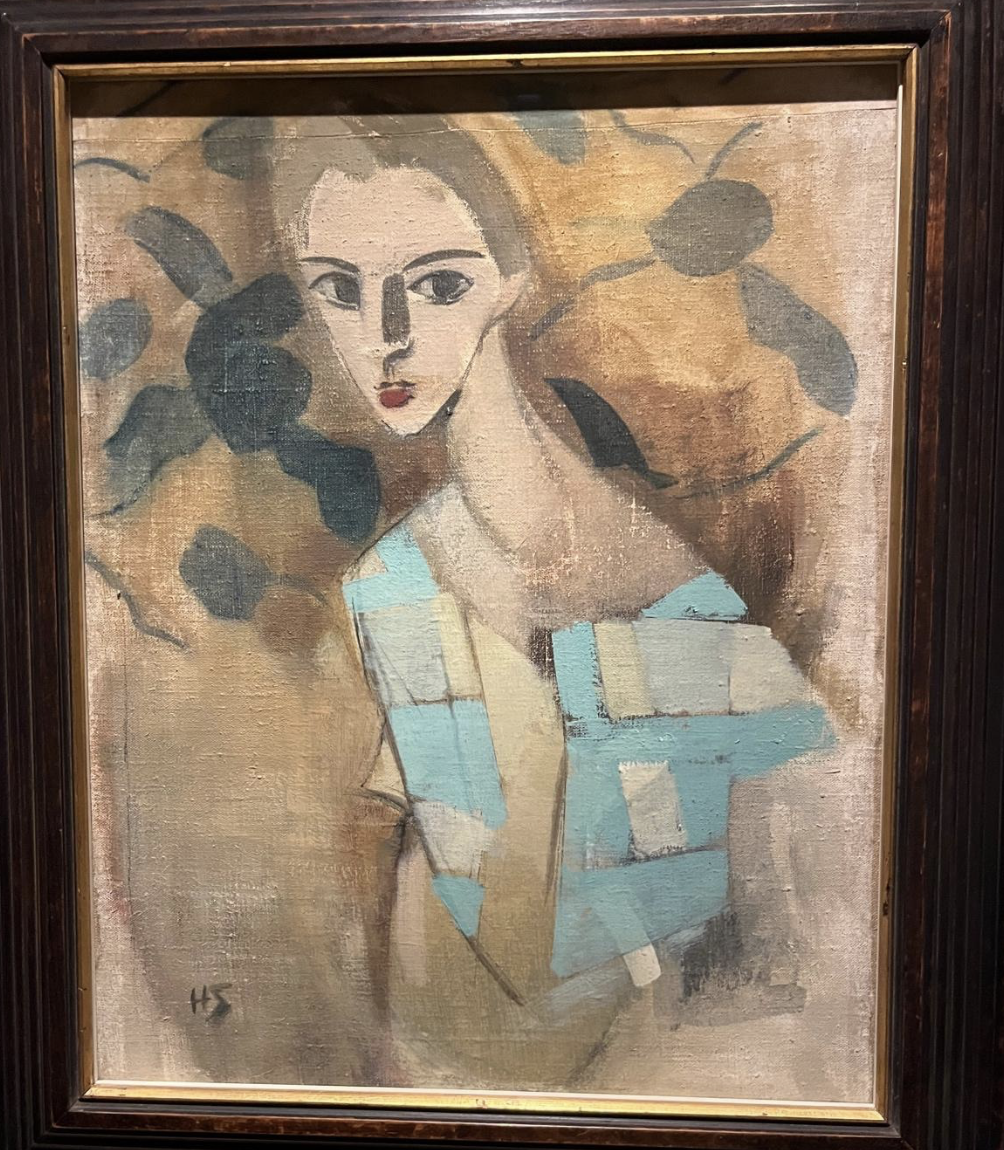
Helene Schjerfbeck, Girl from Eydtkuhne II, 1927.
But why try to describe when I can show? Why speak (to reshuffle Wittgenstein’s phrase) when I can be silent? Critics and connoisseurs must have their say, and they help to steer us, to focus and sharpen our attention, provide details and context. But then it is always the art that must speak to us directly, without mediation or interpretation. It can never be silent.