Fiction, like art in general, expands our mental and emotional reach by connecting us to lives and worlds beyond our own. The words on the page or the paint on the canvas usher us into other lives. They also connect us to others who share the same experience of audience, and thus make particular conversations possible.
E.M. Forster, in his novel Howard’s End, exhorts us to “only connect.” And Joseph Conrad writes in his Preface to The Nigger of the Narcissus, also known as “Conrad’s Manifesto,” that “…there is not a place of splendour or a dark corner of the earth that does not deserve, if only a passing glance of wonder or pity.”
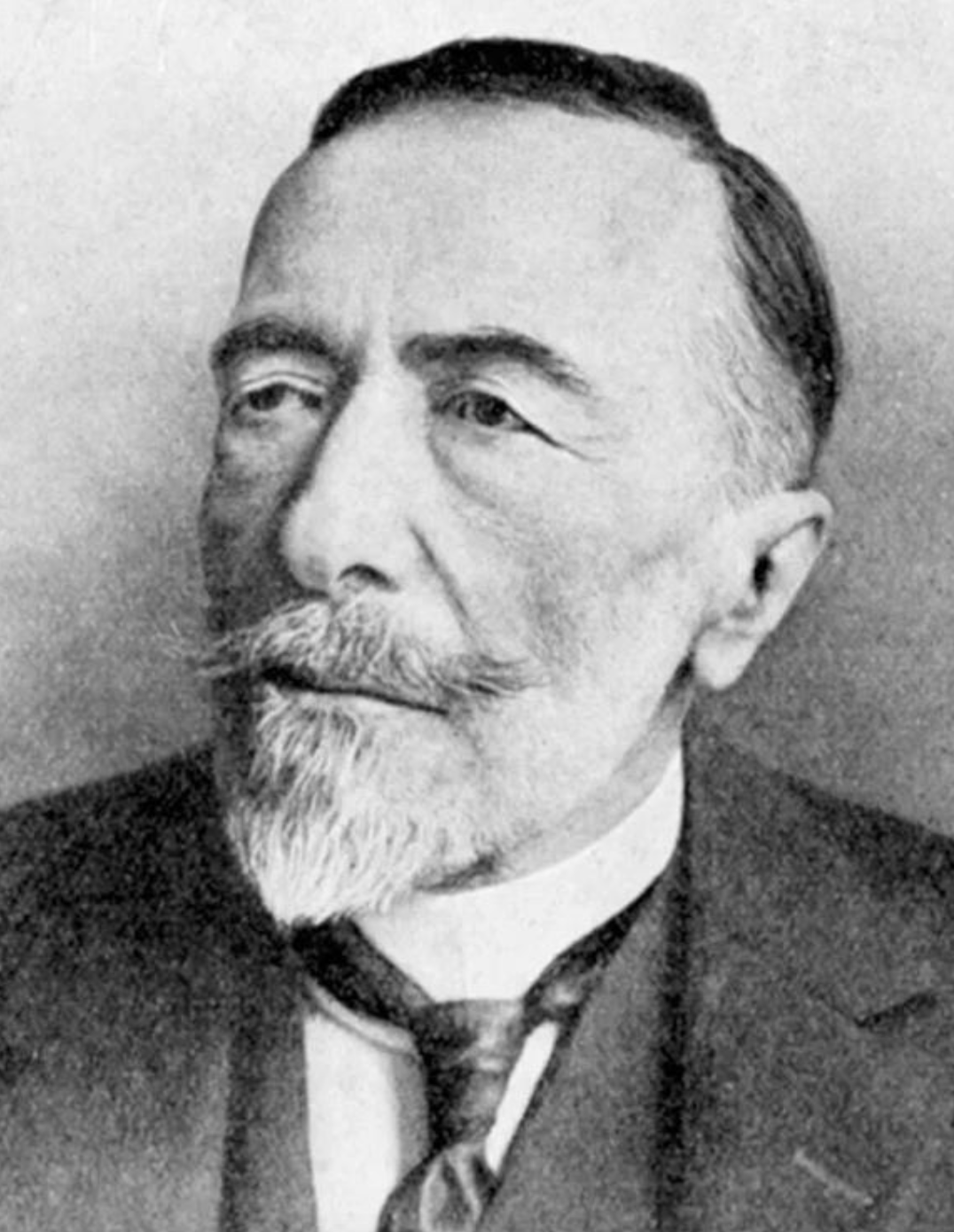
Joseph Conrad, born Józef Teodor Konrad Korzeniowski (1857-1924)
I love that sentence. But as I’ve learned since first reading it a half-century ago, there are times when we must distinguish rather than connect. And (more often) there are times when we must do both, concurrently or sequentially as the case may be. Obviously, it’s context-dependent.

Edward Morgan Forster (1879-1970)
Morality bids us to connect, not to separate from others: to see every person as our prima facie equal. So does democracy, in its radical political equality – one person one vote, and equality before the law; and so, in many contexts, do the liberal arts. Complex ideas and situations call upon us to make distinctions as well as connections, to compare and contrast, divide and unite. A liberal education is, in the broadest sense, an exercise in connecting oneself to the world. But in the critical mind, those two functions, associative and dissociative, always coexist. So too in the creative mind. More than that, the two functions must cooperate.
I’m thinking in this context about antisemitism and what I consider the egregious abuse of that term nowadays. We’re now talking about a rich stew of American discourse and intellectual and moral rigor – or the lack of it. When a term is abused for political advantage, whether it be fascism, communism, antisemitism, or anything else, there is a moral deficit: a linguistic injustice as it were. Such is the case here. As Patrick Iber writes on the Editor’s Page of Dissent Magazine (Winter 2026):
One purpose for Dissent was to rescue the idea of socialism from those who claimed it for authoritarian ends. And that points to a problem with our vocabulary. Across the globe, a few big concepts define political orientations: liberalism, socialism, capitalism. But each of these categories contains multiple meanings, including internally contradictory ones. There are struggles between ideological camps, of course, but there are also struggles within them over how to define these categories for the public.
One culprit in the current discourse mess, and one of the flashpoints that is both geographically and otherwise close to me is Columbia University. Columbia and I go back. I attended two graduate programs there, as did my parents before me and various siblings and countless relatives, beginning with my grandfather, who graduated from the university in 1913 (where he met my grandmother, who was attending Barnard.) So, when Columbia disgraces itself – whether in dealing cravenly with the Trump Administration, or by taking a dishonest approach to antisemitism – it’s troubling.
By dishonest, I mean using a definition of antisemitism that blurs the line between hatred of Jews, on one hand, and fair criticism of the state of Israel on the other. It’s a clear line, yet one that some politicians, some Jews, and most Trumpists, find it convenient to erase. Especially eager to erase it are those who don’t want to think that Israel has committed war crimes in Gaza, or anything that could remotely be considered genocide. Beyond those groups, the overwhelming consensus is that Israel’s conduct in Gaza since 2023 is either genocidal or genocide-adjacent.
Calling such criticism “antisemitic” relieves one of the nuisance of debating the facts – or even facing the facts. It’s a case of both connecting and dividing: connecting to one’s tribe and dividing it from other tribes and from everyone else. We all do it to some extent. I’m no exception; I belong to the tribe of Mets fans, and that separates me from the tribe of Yankees fans. Not that I like tribes; I find that they divide much more than they connect.
Another term subject to abuse, or innately abusive, is “self-hating Jew.” I won’t dignify this ugly aspersion with analysis, except to say that I probably qualify as one such creature, based on the implied definition; I just don’t happen to hate myself. But it’s all about the gaslighting.
My larger point (which I will explore in future posts about the nature of morality, and what it’s like to be, in Stalin’s words, a “rootless cosmopolitan”) is that how exactly we divide and how we connect matter greatly: how tightly, and along what fault lines. We have every right to our affinity groups. (My own spiritual universe is summoned into form, leading to personal moments of transcendence, by the holy incantation: Play Ball!) But we get in trouble when our emotional attachments cloud our reason and our moral arguments.
Call me what you will (“self-hating Mets fan” would seem to fit) But if we can’t see beyond your personal interests or or clannish affiliations, just don’t call it moral discourse. We must learn with Forster and Conrad to connect – not just to our tribes but to humanity – or else we’re doomed to endless cycles of violence. And based on human history, who can say we are not?