
Like a lot of people, I enjoy reading novels and short stories. I only write nonfiction (and the occasional bit of whimsical free verse); but I get pleasure on a more regular basis from fiction. This is a source of some wonderment for me, particularly given that I don’t just feel incapable of writing fiction – which is not surprising for someone of an analytic bent with a background in philosophy; I even find the idea of trying to do it vaguely disturbing and illegitimate.
I don’t mind at all that Tolstoy or Melville, or many contemporary novelists, have churned out books; I just lack the urge to make stuff up. I’m lazy, and making stuff up is hard work. And yet, this seems inconsistent with the pleasure I get, and the deep need that is satisfied, when I read great fiction. And if I could only bring one author with me to a desert island, it wouldn’t be a philosopher. Hands down, Mark Twain.
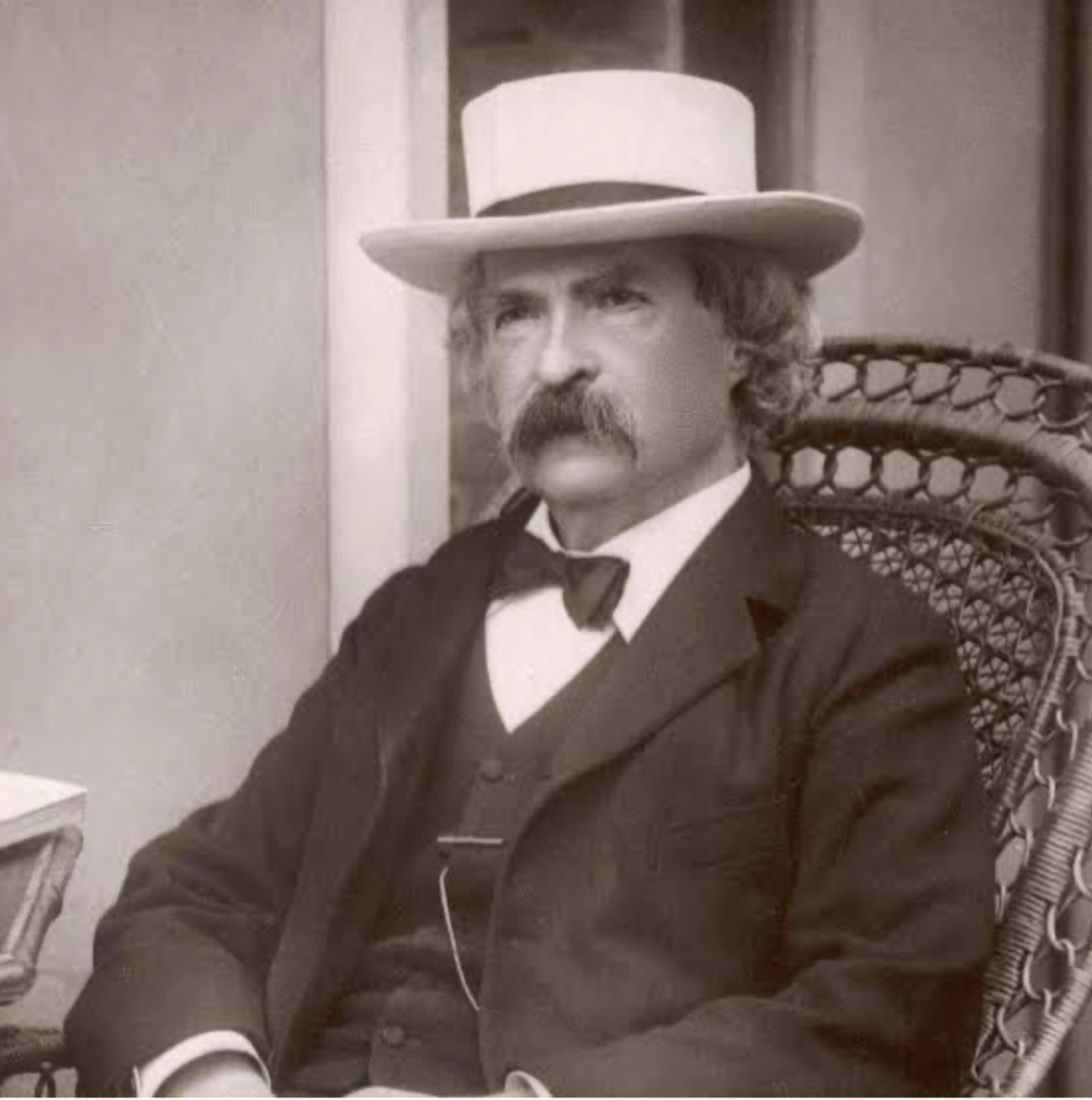
Mark Twain (Samuel Langhorne Clemens, 1835-1910) was the founding father of American humor and, along with Melville and Poe, of modern American fiction.
I’m not a natural storyteller, but I’ve always enjoyed storytelling by others, since long before I began to write the serious books and ponderous essays that seem to be my true calling. I don’t intend to solve this riddle, but I want to poke around in it a bit. I’ll begin with the fact that I wonder, and admire, how fiction writers do it. The feel they have for a time, a place, a character, a relationship – the real stuff of life, you might say. The ability to produce out of their imaginations what can seem like authentic human dialogue. I’ll admit that I even admire bad, or at least mediocre, fiction writers, and further concede that if I could write a mediocre piece of fiction I would do it, just for the hell of it. Just to prove to myself that I could. But it’s unlikely I’ll ever try.
The deeper conflict is that I appreciate and enjoy what fiction writers produce, and have the utmost respect for their talent, but when I imagine doing it all the value drops away, as if the very idea of it threatens me because it’s so antithetical to who I am. And yet, if anything, my addiction to reading fiction has accelerated in recent years. So, what’s it all about? Something besides hypocrisy, I suspect.
All humans, even those of us who are indentured to more abstract species of nonfiction, have a story gene. Our minds need make-believe narrative arcs that mirror and explore and deepen our understanding of our own lives. They confirm who we are, who we aren’t, and the fact that we are like (or a little better than) these imaginary others. I would have been a more reasonable and sensitive whaling captain than Ahab, but his monologues are a magical blend of poetry and philosophy.
In a recent post I talked about The Remembered Soldier, an extraordinary book by the Dutch novelist Anjet Daanje. I was amazed by its comprehension of how marriages can work and how they can fail. I can’t remember another book that delved so deeply into the murk of marital intimacy, at the physical level as well as the emotional, the practical – how they manage a life together – and in a distinctive historical context, the aftermath of World War I. I didn’t want it to end.
I’ve also been deeply engaged by writers such as Roy Jacobsen, Ian McEwan and John Banville. And I have a particular bent for female writers, roughly from Virginia Woolf onward, and how they imagine the world. Daanje is only the latest in that line. Inevitably, there’s an element of voyeurism in my fascination with women writers that male writers don’t elicit as much. It might have something to do with the fact that they are different from me.
Sheer escapism is one element of my attachment to fiction, and I don’t apologize for it. We all need to escape into other realities now and then, to see the world through other eyes, hear other voices, and conjure other times and places. It refreshes us to face the grim realities of the everyday. Books that afford this kind of escape (without being purely “escapist,” and therefore vapid) tend to trespass on familiar avenues of inquiry: history, morality, psychology, contemporary society, not to mention religion, politics, and much else that we can learn from the imagination rather than from research, analysis, science, or field work.
Like all human communication, escapist literature (or film or theater) can be a kind of schooling; and such schooling can be fun, interesting, draining, or amusing. A recent post on the play “Giant,” for example, suggested how it exposes questions and raw debates about antisemitism and literature.
At another level, fiction is voice; and while I manage to write in one or two voices, depending on the subject and genre, I have no need to add new voices to my own repertoire – yet I feel compelled to read other voices, and fiction is where they mostly reside. Exactly what need they satisfy, what itch they scratch, or how they relate to or enrich my own voices, is unclear. But I get into enough trouble writing about what seems clear to me without delving into what doesn’t.
Of all the categories of understanding that constitute the liberal arts, I believe good fiction privileges two in particular: morality and psychology. If I’m right about that, the reason is logical in nature: the nearly universal stuff of stories is human conflict, and such conflict can easily be subdivided into internal and external conflict. Internal conflict is the terrain of psychology, and external (from human relationships to social conflict to warfare) is the stuff of morality. Of course, these broad categories can both overlap and conflict.
Life is messy. Fiction gives us arcs, neat or otherwise, and our own lives are narrative arcs. Why shouldn’t we lose ourselves for a while in the arcs of imaginary others? We both learn and enjoy, and those categories, too, are intertwined. And so, I read avidly and far more broadly than the narrow grooves in which I prefer to write. Or that’s the story I tell myself, at any rate.