
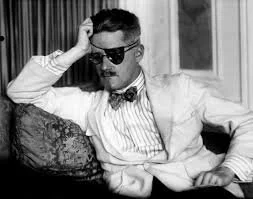
James Joyce’s “Dubliners,” from 1914, is pretty widely regarded as the greatest collection of short stories in the English Language. I can’t think of a better one, though I’m deeply impressed by the stories of a contemporary Irish author, Claire Keegan. And Joyce’s culminating story, “The Dead,” is the longest, best-known, and possibly the greatest of the group.
Reading it for the third time recently, in preparation for a seminar, I had the almost unique feeling of flowing down a river. No need to steer or paddle, just drifting along, attentively, on a smooth and deep current of prose. Smooth in its polished surface, deep in its reach.
I would like to briefly examine this river metaphor. I didn’t have to think about it or scrounge for it; the image formed in my mind as I was reading. That doesn’t happen when reading Huckleberry Finn, Twain’s (and perhaps America’s) greatest work of fiction, which is about an actual river journey; nor does it apply to Life on the Mississippi, Twain’s great nonfiction account of the Big Muddy. And it certainly doesn’t happen in Joyce’s masterwork, “Ulysses.” Fluidity isn’t everything; but in “Dubliners,” and most of all in “The Dead,” the words just seem to flow.
“The Dead” is about death, dying, and the effects of the dead upon the living. (We learn that life is temporary, among other things.) But Joyce’s prose contains wisdom about life, human nature, men, women, and Ireland. And astonishingly, he wrote it while still in his early twenties.
The river metaphor works best with great narrative writing. You are on a voyage mapped out by the author, moving at his or her pace. (One could say the same for film). Some of the great writers accomplish this – Tolstoy and Chekhov, among others. In “Dubliners” it is a slow but steady forward motion, observant of the landscape and conscious of the depths. There are no shocks or surprises, just a steady, subtle accumulation of scenes, characters, ideas, and a consistent mood of sad but seldom tragic contemplation.
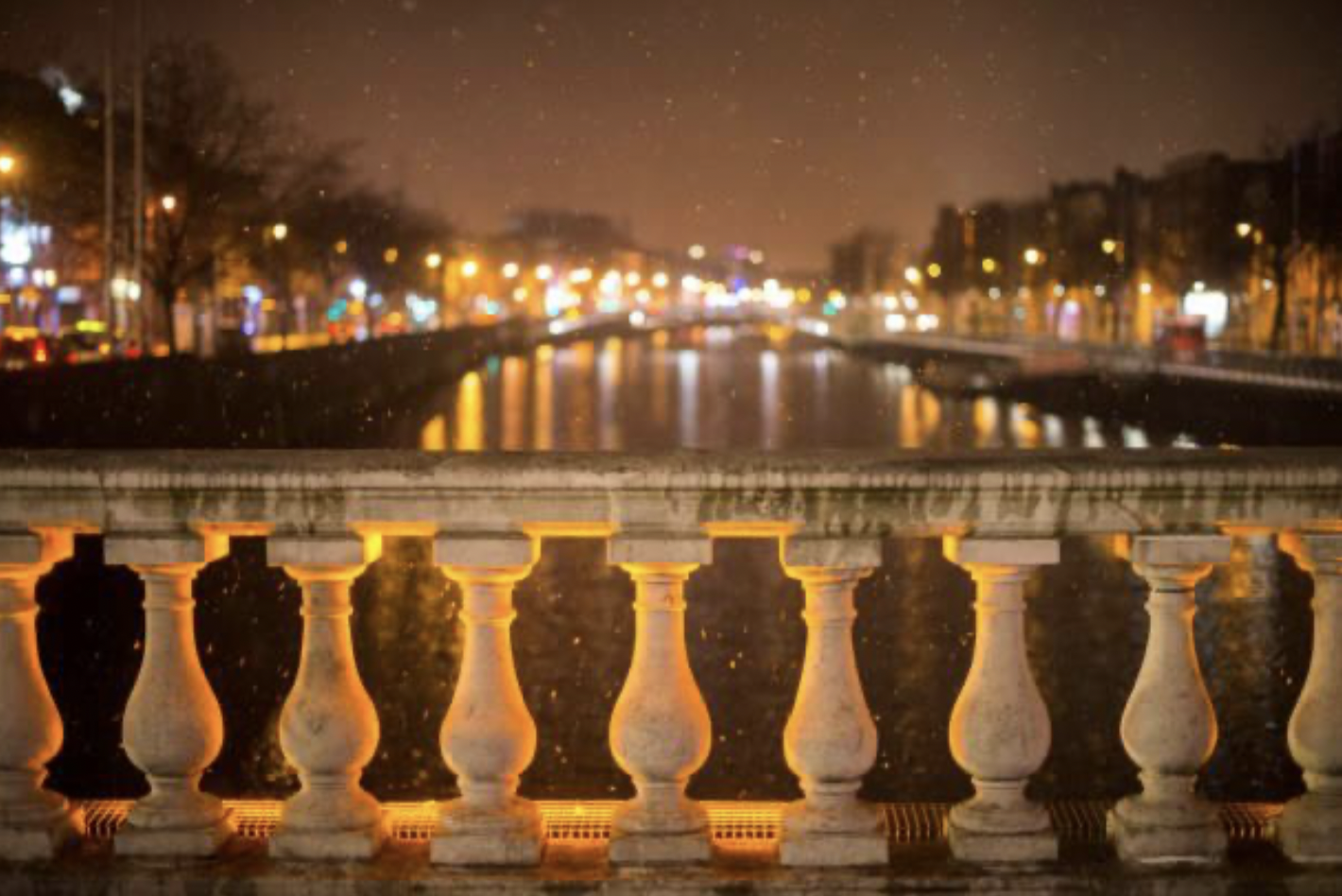
In “The Dead,” the journey is dreamlike in its smoothness (but are dreams always smooth? Maybe that analogy fails). It begins at an Irish dance party on a wintry evening, and ends in a Dublin hotel room, where the couple at the center of the story are putting up for the night. The snowfall adds both beauty and a sense of mortality to the mood. This being early (pre-Ulysses) Joyce, there is a kind of epiphany at the end. Here in “The Dead,” it’s about acceptance, forgiveness, and love. More epiphanies were to come in Joyce’s brilliant precursor to “Ulysses,” his autobiographical “A Portrait of the Artist as a Young Man.”
I’m tempted here to quote from the elegant final paragraphs of “The Dead,” but I think that does his work, and you the reader, a disservice. The prose is more powerful coming at the end of the story than taken out of context. It’s integral to the whole; as Conrad put it, “A work that aspires, however humbly, to the condition of art should carry its justification in every line.” There’s not much in “Dubliners” or in “The Dead” that needs further justification. So rather than read about “The Dead,” you can read it, and thank Mr. Joyce for enriching us all.