
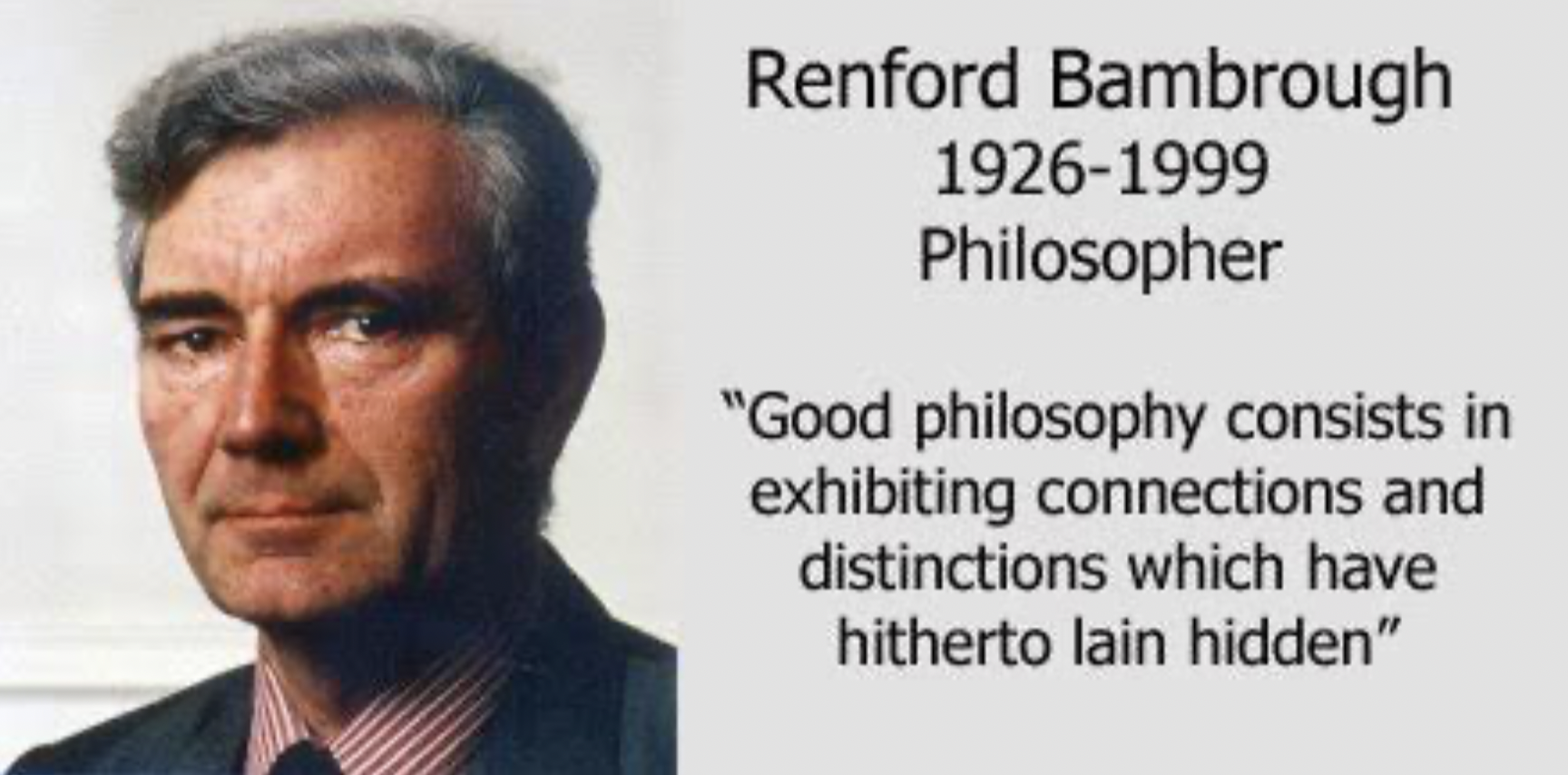
It may sound odd or even unphilosophical, but a single essay, just under sixteen pages in length, which I first read in the 1970s, has influenced my thinking more than anything else I’ve read in philosophy. And it’s an essay that I return to every few years to get, or retain, my bearings.
That’s saying a lot; I’ve studied Kant’s Critique of Pure Reason and Wittgenstein’s Philosophical Investigations, monumental works that have profoundly influenced me. That’s not to mention Plato’s dialogues and the works of Aristotle, arguably the most reasonable thinker of all time. All these philosophers, and many others. have helped shape my philosophical orientation.
The essay I’m referring to is by a philosopher I’ve mentioned in the blog named J. Renford Bambrough. He taught at St. John’s College, Cambridge, and died in 1999 of Lewy Body Disease. I’ve read most of his modest oeuvre, which includes two excellent little books on morality and religion and some forty essays. And like many among his cohort of British philosophers (Stuart Hampshire and Bernard Williams being among the names that stand out) he writes beautifully, making his arguments that much more accessible to non-philosophers. There’s a fluidity to British philosophical prose that American counterparts seldom match – but that’s another story.
I love all of Bambrough’s essays, which I’ve described as the philosophical equivalents of Rembrandt miniatures (in a 2009 essay that appeared in Philosophy Now); I’m presently co-editing an anthology of them. But the one that stands above the rest, in my estimation, is “Aristotle on Justice: A Paradigm of Philosophy,” which originally appeared in a book that Bambrough edited, New Essays on Plato and Aristotle (Routledge & Kegan Paul, 1965). The reason it stands out is because it is a paradigm – of rigorous analytic thinking, if not of philosophy in its entirety. (I’m not sure we can speak of philosophy as having an “entirety.”) Each time I read it, I come away exhilarated and feel that I’ve recaptured at least a modicum of intellectual rigor.
I must have devoured “Aristotle on Justice” at least seven or eight times over the years. Most recently, in preparing for this post, I perused it for the first time in a decade or so. This time around (and not for the first time) I had a nagging sense that in my younger years I could follow Bambrough’s argument just a bit more closely and understand more of its finer points; that happens. And yet, I found myself smiling through it with a profound sense of recognition, agreement, and gratitude. If Bambrough was wrong about the very nature of philosophy (Aristotle and his concept of justice are merely a pretext for his larger argument) then I’m happy to be wrong along with him.
Bambrough begins by considering how Aristotle uses the term dikaiosyne (“justice”) in two distinct senses in the Nichomachean Ethics. It stands both for justice in general and for a particular virtue, a will to be fair. He then explores why Aristotle uses the word in both ways, instead of in just one way, and what is gained and lost in that choice. Taking off from there, Bambrough leaves Aristotle behind, so to speak.
What he considers a paradigm of philosophy can be encapsulated in this way: First, we have to make both distinctions and connections between things; that is how our minds work, and how we identify “things” at all. Distinctions and connections are the ultimate nuclei of thought. Second, distinctions nominally obscure connections and vice versa. Therefore, third, analytic thinking consists of both making distinctions and connections and revealing the distinctions that connections obscure and vice versa. As Bambrough writes in the opening part of the essay:
Good philosophy consists in exhibiting connections and distinctions which have hitherto lain hidden; in drawing distinctions without obscuring connections, and marking connections without obscuring distinctions… It is because all or most ways of marking distinctions or connections between concepts have clear advantages and clear disadvantages that philosophy is so difficult and so controversial.
A fourth part of the analytic equation, which Bambrough implies but doesn’t make explicit, is this: to communicate meaning we have to use words, but individual words can’t, in most cases, get the job done of mapping all useful or significant meanings. Words leave both distinctions and connections obscured. The only cure for that is to use more words – that is, to use extensive language: analytic discourse or, if you prefer, dialectic – to expose what single words cannot.
Once this basic framework is mastered, everything fits into it. Bambrough’s schema of revealing connections and distinctions explains what the Greeks were doing, and what most philosophers since have been doing. It’s hard to imagine what else one might need – not to be a philosopher, but to be a rigorous analytic thinker, regardless of the subject matter.
Wittgenstein’s idea of family resemblance, as Bambrough himself suggests, goes even further to clarify the process of analysis, of showing how things are related and how they are not. But in “Aristotle on Justice” the groundwork is laid, not just for philosophy but for all rigorous thinking. That is because rigor itself is quintessentially philosophical: attention to formal logic, informal logic, and analytic depth, breadth, and clarity. To distinctions, connections, and what they reciprocally obscure. When we attend to these, we’re approaching the very essence of meaning.
“Aristotle on Justice” isn’t the only Bambrough essay that I admire; “Universals and Family Resemblances” is another, although in truth I like nearly all of his work. And not just Bambrough, or just philosophy. I have dozens of essays in my files—on philosophy, literature, the media, the liberal arts, and other subjects. I’m something of an essay hoarder. (I also like to read books, but they take up more room, and especially in philosophy I find essays more focused and succinct.)
My runner-up for favorite philosophy essay would probably be W.B. Gallie’s “Essentially Contested Concepts,” published in the Proceedings of the Aristotelian Society in 1956. That one is a knockout. If the citation strikes you as old and obscure, forgive me, but you’re looking through the wrong end of the scope. It’s all about the ideas, and Gallie’s are brilliant in much the same way as Bambrough’s. (I’ll be writing about Gallie and the idea of contestability in a future post.) Another intellectual treasure is the work of Bernard Williams, to name just one additional philosophical North Star.
I’m not saying everyone should hoard essays, but it works for me. I’ve also hoarded books, desks, cheap vintage pens (Paper Mates are my favorite), not to mention baseball caps. You would be too generous to call me a collector. But of all these fine and highly affordable objects, essays have provided me with the richest return. They nourish my soul. One could do worse.