
I’m old enough to remember when college and university bookstores contained a lot of interesting books and journals – and that’s pretty old. Even at my small liberal art college, the bookstore was a marvel. And my favorite holdover volume from those years (aside from the Concise Oxford Dictionary, which I wrote about in “The Thrill of Reference”) is a lovely curiosity titled Greek Philosophical Terms: A Historical Lexicon, by F.E. Peters, published in 1967 by New York University Press.
The 245-page volume (now available in paperback) is a Synagōgé (collection) of extended definitions of the key terms and ideas of the Ancient Greeks. Entries vary from a paragraph to several pages. A is for Adiáphoron (a state of moral indifference or neutrality); C is for Chrónos (time); D is for Dialektiké (dialectic); Z is for Zóön (living being or animal); and so on. In case you were wondering, there is no B.
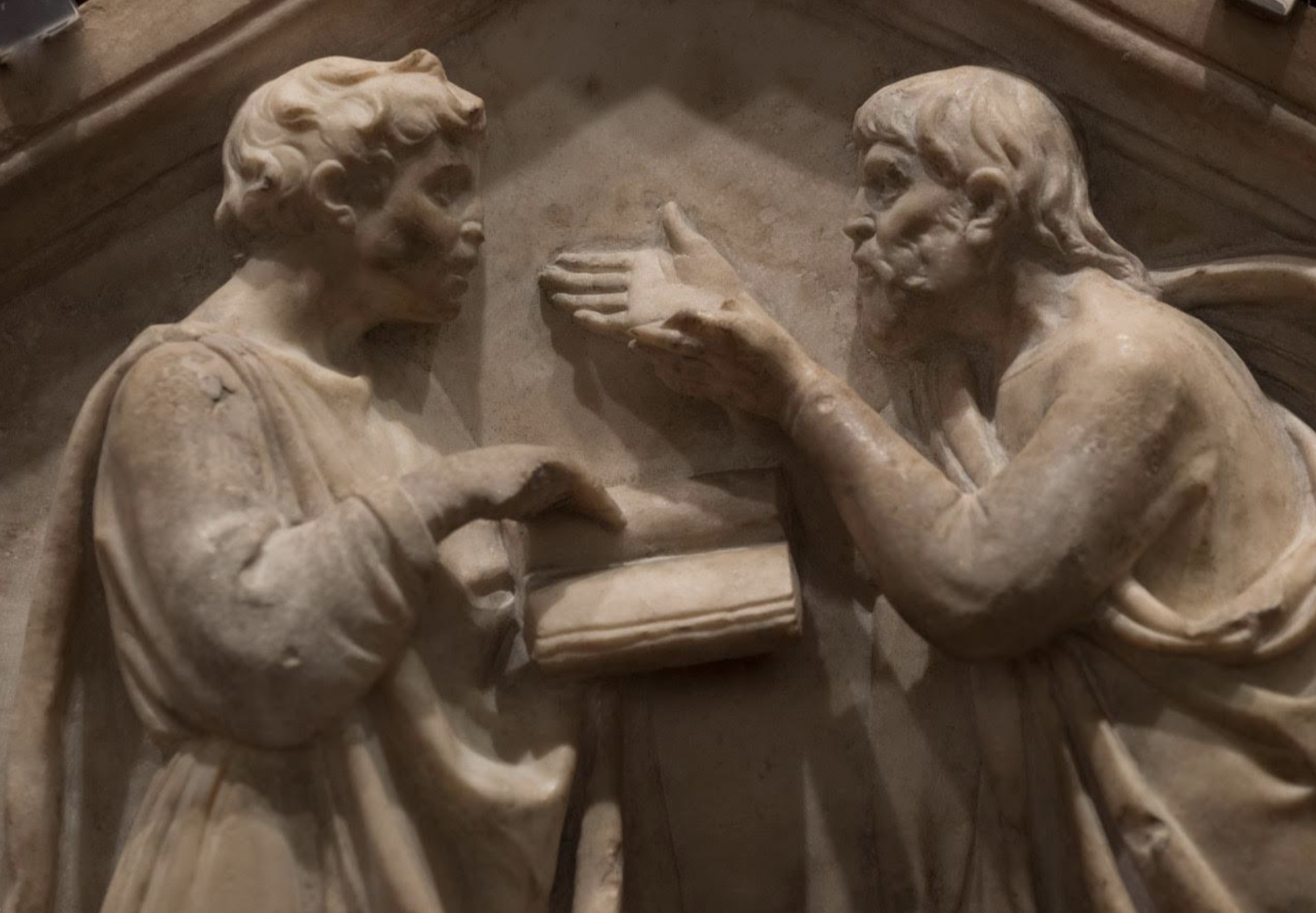
Plato and Aristotle in Discussion (1437-1439) by Luca della Robbia, marble relief panel for Giotto’s campanile in Florence.
I admit to having a reference fetish: a passion for concise, accessible knowledge of general topics and ideas. Like the Oxford Concise Dictionary of Linguistics, which I keep in my bathroom.
I regret that I don’t know Ancient Greek; but anyone interested in the great ideas that have framed the Western liberal arts tradition – thought, knowledge, perception, causality, truth, beauty, etc. – will find something of interest in Peters’ little volume. It’s a wonderful browser.
That’s one reason I cherish Greek Philosophical Terms. The other is a brief preface titled “Language and Philosophy: A Preliminary Note.” The four-page essay is an elegant statement about the indissoluble connection between thought and language, and it’s worth the price of the book.
Peters wasn’t officially a philosopher, but a professor of History and Near Eastern Languages at New York University. As a Hellenist, however, he didn’t just know his Greek; he knew his ancient philosophers. A classicist is perforce a philosopher.
On the general subject of literary treasures, another work I’ve recently returned to after many years is Fly and the Fly Bottle: Encounters with British Intellectuals, by Ved Mehta. Written in 1961 and based on articles in The New Yorker, Mehta’s book isn’t a reference work but a report on the atmosphere and debates among historians and philosophers at Oxford in the 1950s. Those debates revolved around important disputes on issues – many of them centering on the philosophy of language – that have not gone away; and the appeal of Mehta’s account is more than just historical. It’s a very different book from Peters’ lexicon, yet in some ways they are similar. Both enable you to dip your mental toes into the deeper pools of Western thought, repeatedly, until you’re dripping with insights.
Mehta’s title is taken from Wittgenstein’s assertion that philosophy is based on linguistic and intellectual errors and their correction. As Wittgenstein famously wrote in the Philosophical Investigations: “What is your aim in philosophy? To show the fly the way out of the fly-bottle.” Never mind that there’s a lot more to philosophy than Wittgenstein supposed – or even to his own philosophy, as his magisterial Investigations and other posthumous works attest.
I’m now perusing both Mehta and Peters again. There are hundreds of other books, both fiction and nonfiction, that I still hope to read or reread. But I reckon that any great book is worth at least a second pass. You may even learn more from it that second time around than from a new one of unknown qualities. As you may have noticed, as a reader and as a writer, timeliness just isn’t my thing. Luckily, it’s other people’s thing, because we need more immediate knowledge too. But it wasn’t front of mind for the ancient Greeks either.
You may not share my interests in philosophy, history, language, and their interconnections. But having a few such books on hand, ones that function not just as friends but lifelong mentors, is not a bad way of staying smart. Or in my case, of stemming the inevitable tide of stupidity, a project to which I’m just as fiercely devoted. It calls for both Sophía (theoretical wisdom) and Sōphrosýne (self-control, moderation). I’m not sure which is harder to approximate.