
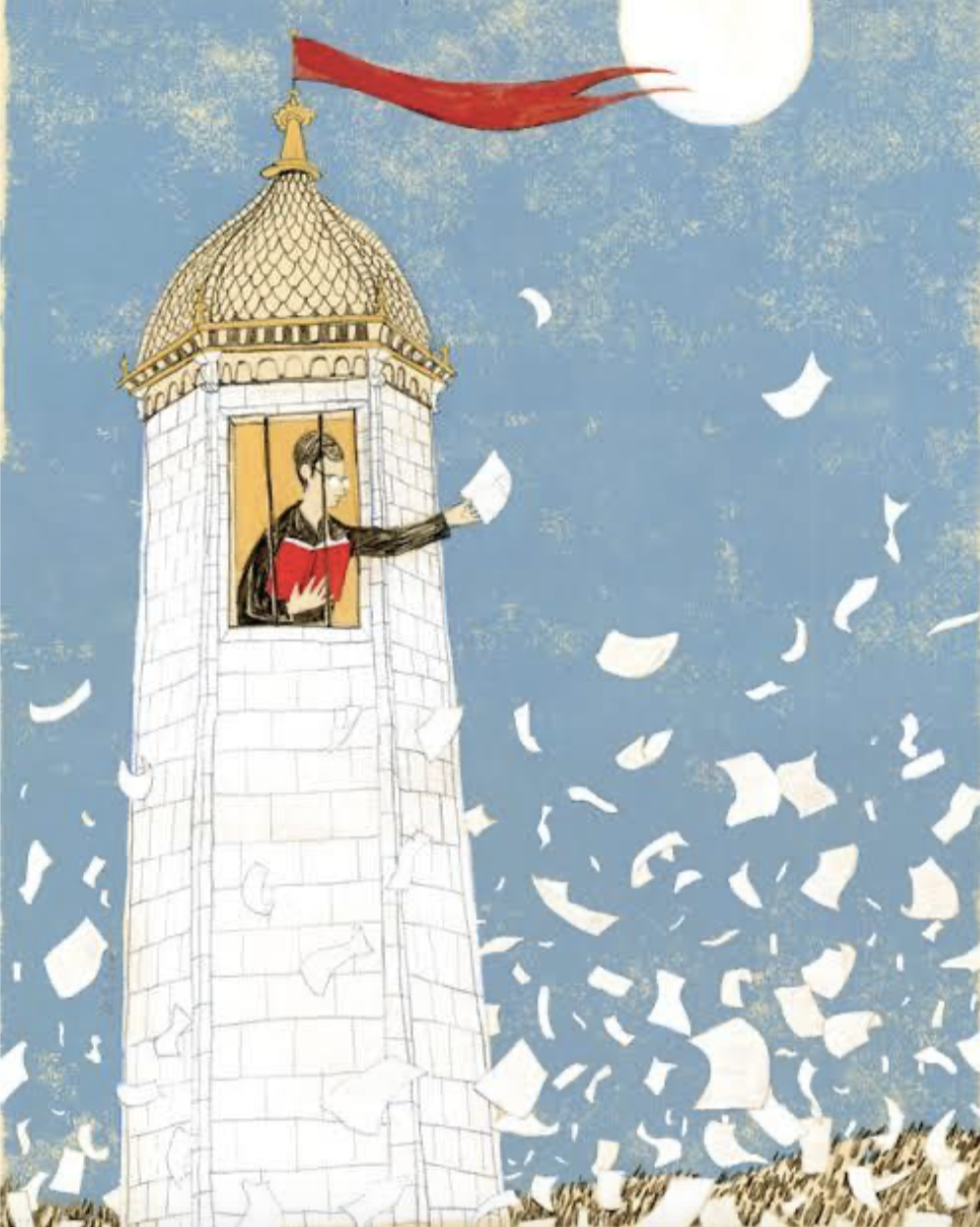
Once upon a time there was a princess named Corinne, who lived in an ivory tower. Her full name was Corinne Ticklethinking, and people made fun of her name, as the unwise often do; but she persevered despite the bullying. They also mocked her for living in a tower, but in fact she had a much broader view of the world than they did.
Corinne was, in effect, an orphan, because her immediate family, all of whom were philosophers, had disowned her and stuffed her away in the tower. They viewed her as a commoner and thus beneath them; but her blood was that of philosophical royalty. But her ivory tower wasn’t a place of privileged seclusion; it was a perch from which she shared her learning as widely as possible with anyone who ventured to climb the tower.
And Corinne wasn’t entirely abandoned. She had a kindly stepfather named Prof. Dewey, who helped to raise her. And she also had a much older friend, the mother of an enormous family, with whom she was extremely close. Her older friend’s name was Libby – Libby Relarts. (She too was sometimes bullied.) And although Libby was much older than Corinne, they went everywhere together. They both had Greek ancestry, and Libby even liked to say that Corinne was part of her own DNA. But no one knew what that meant, because in those times no one had heard of deoxyribonucleic acid.
The wise Prof. Dewey understood Corinne’s noble heritage and supported her and helped her to mature. He recognized her potential as a teacher who could bridge the gap between philosophers and everyone else; and gradually she became known to the world. Meanwhile, it was endlessly debated whether Corinne Ticklethinking should be allowed to teach on her own or instead should remain under the wing of Libby Relarts.
Later in the 20th century, scholars began to study Corinne Ticklethinking, and some of their work was good; but they could never agree on who she really was, or which of her attributes were most important, so they didn’t know how to locate her in the world of higher education. People in and out of academia liked to drop her name, without ever really identifying her or acknowledging her royal philosophical blood.
In fact, most of the scholars who paid attention to Corinne were from departments of education, rhetoric, and the like: important fields of inquiry, but ones that had been marginalized by mainstream academia. No one else paid much heed to what these scholars explained about Corinne, least of all the philosophers from whom she derived her parentage.
Life went on, and eventually the name Corinne Ticklethinking became a buzz word. Everyone thought they were the prince who had discovered this Cinderella of higher learning. But as so often happens with buzz words, those who spoke of her often didn’t really know much about her, or if they did, they couldn’t be bothered to explain her.
Some students said they couldn’t “relate” to her, with her wider perspective from atop the ivory tower. However, this wasn’t Corinne’s fault. She wasn’t old-fashioned or irrelevant. Rather, these students weren’t properly taught how to relate to their elders or how to think. They weren’t taught that it’s their job to “relate” to the world, and not the world’s job to “relate” to them.
Libby Relarts, though her popularity has diminished and fools have attacked her, keeps on going. The same is true for Corinne TIcklethinking. If you look at them closely you can see the resemblance, based on their common Greek heritage. Libby’s vast teachings remain founded on Corinne’s ideas.
Although Libby is a mother many times over, and Corinne remains an orphan of unclaimed parentage, they are the twin priestesses of wisdom and intellectual maturity. To some they may seem like aging ghosts, rocking on the academy’s porch and not really worth engaging with. What such people don’t understand is that they themselves are ghosts – the ghosts of another Greek idea: Democracy.
(NOT) THE END