
I’m not a great believer in idealizing philosophers or their ideas. For one thing, philosophy is too complicated for any one thinker to get it right – if “right” is even the right word. (Compelling, edifying, or clarifying might be better.) At best, the great philosophers are like the proverbial blind men, each of whom senses just one part of the elephant. Even as a young philosophy student, what struck me about the field was how a few dozen (mostly white, male, European) thinkers could make such compelling arguments for wildly disparate ways of organizing thought and reality. They couldn’t all be right – yet I also learned that none of them is entirely wrong either.
A further reason to be skeptical of shiny intellectual objects is that philosophy is, to a great extent, a cumulative and evolving process. We stand on the shoulders of giants, and if we see farther than they did, it’s entirely because of what they saw. At the same time, it’s also an inherently critical enterprise, and it’s our duty as readers to be critics of it. That doesn’t mean tearing everything down but rather finding both the strengths and weaknesses in a text. It’s a duty of all rigorous thinkers, in fact, in any discipline.
Finally, ideas that are useful or valid should not be confused with ideas that are lovely or validating or simply make us happy. That particular lapse in critical thinking is rampant across the human species. We should beware of notions that have aesthetic appeal as distinct from having specific traction on reality, by clarifying it, simplifying it, or reflecting its actual complexity. I want to say that when it comes to ideas, lovely shouldn’t count, unless it’s an emergent quality of those other intellectual benefits.
Plato’s theory of forms is appealing because it strikes out so boldly in the right direction, toward separating things from ideas, attributes or properties, even though it remains crude. Likewise, Wittgenstein’s concept of family resemblance (see the post of Oct. 4, 2025). It’s both strikingly original and deeply common-sensical. But we tend to adopt, as household pets for our mental dwellings, notions that please us rather than ones that mirror the world or contribute to our agency within it.
Having belabored the point about pretty ideas, I now want to qualify it somewhat. I’m not sure that intellectual and aesthetic or emotional appeal can always be neatly distinguished or segregated; I’m not sure philosophy and poetry have nothing to say to one another. It’s okay to find pleasure or beauty in an abstract idea, as long as we don’t surrender our critical distance from it. And how could one survive without somehow believing in the sublime, in the human capacity to experience beauty, harmony, transcendence, one-ness of self and world, free of the rigors of logic and philosophy in general?
I’m thinking here specifically of the Pre-Socratic philosophers: the dozen or so important Greek thinkers from the 7th to the 5th centuries BCE, who came before Socrates and Plato. (Socrates left no surviving texts and we only know him through Plato). I’m thinking about them for two reasons: because I recently read Adam Nicolson’s leisurely cultural travelogue, “How to Be: Life from the Early Greeks”; and because the Pre-Socratics were the first, and therefore the most poetic if not the most beautiful, of philosophers.
In their very intellectual and scientific innocence, the Pre-Socratics pioneered the conceptual and methodological tools that later thinkers would vastly perfect. I say this without any condescension, as an acknowledgement that they were the initiators of the long evolutionary process that is Western philosophy. We can’t fault them for not having the techniques, vocabulary, or critical sophistication of those who came after (beginning with Plato and Aristotle, who represented two giant steps forward). Before the astronauts there had to be the Wright Brothers, and before philosophy as we know it could emerge, there had to be the Pre-Socratics.
The Pre-Socratics left us lovely bits of ideas that are compellingly simple. “All things are water,” for example, is what we mainly remember of Thales of Miletus. (It was actually a little more nuanced than that.) Other significant Pre-Socratics included Anaximander, Anaximenes, Pythagoras, Heraclitus, Anaxagoras, Most of what survives of their writing is fragmentary. Yet in those fragments, they seem fresh and alive, as if diving into a newly discovered pool of thought, attempting to comprehend the unknown through straightforward yet bottomless questions such as “what is the world made of?” and “where does it come from”?
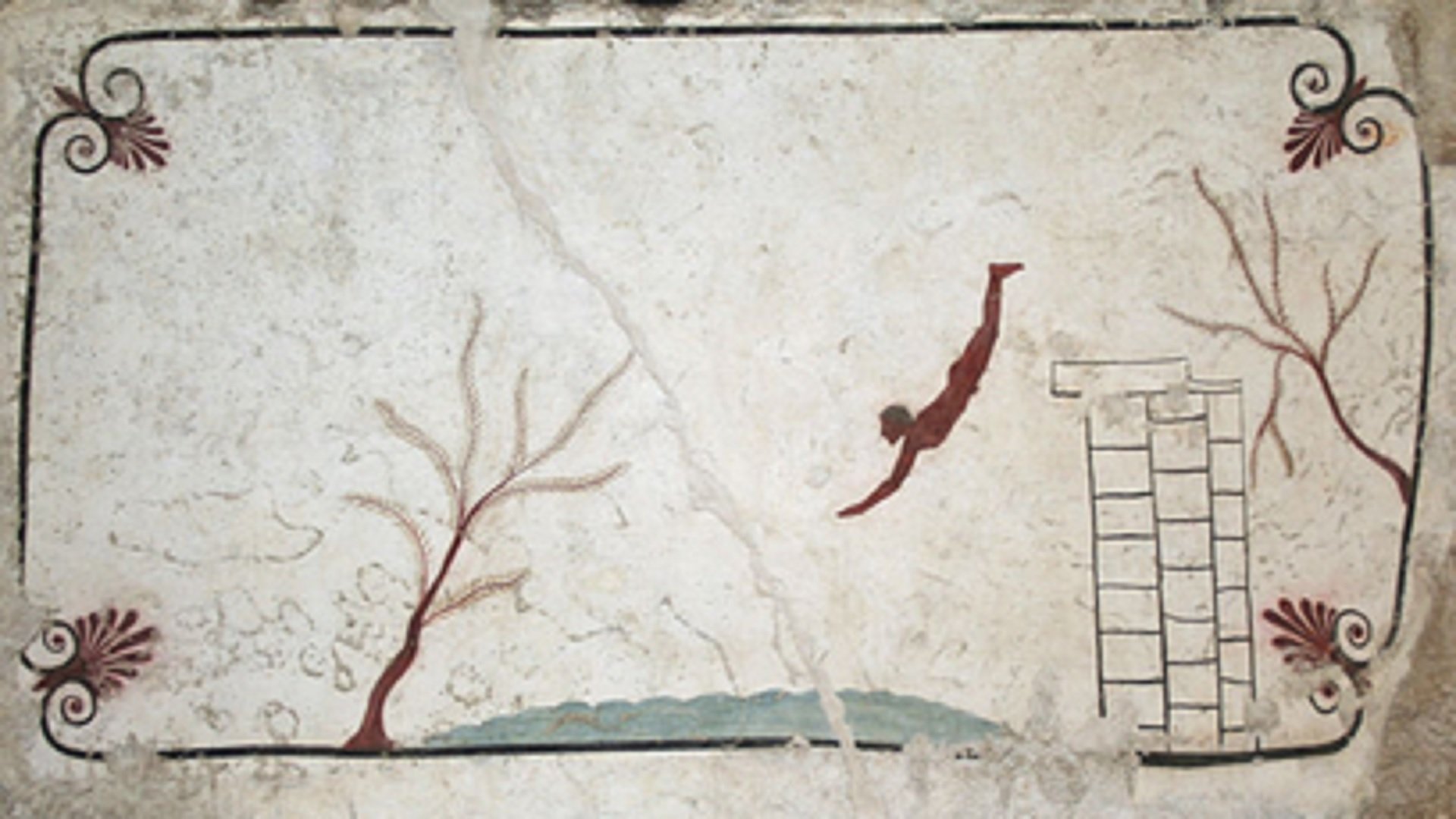
Tomb of the Diver, Paestum, c. 500–475 BCE.
It’s a liberating dive away from prior modes of understanding, which have their own aesthetic or historical value: myth, dogma, mysticism, storytelling, epic poetry. The Pre-Socratics were the first to try to figure things out through pure speculation, moving thought itself down the evolutionary path that would lead to rules, reasons, logic, direct observation, and science. True revolutionaries, they looked for first principles without listening to their gods.
Nicolson, the author of “How to Be,” is also an accomplished sailor, and I’ve enjoyed some of his books about seafaring. This isn’t entirely coincidental. The connecting thread is that he has sailed in the Aegean, and (as he wrote in a lovely short essay for The New York Times) exploring Greek waters led to epiphanic insights into how and why philosophy developed there, among the islands and harbors of the Mediterranean world.
All of this happened, of course, in a world of warring city-states that prospered by trading – including a thriving slave trade with ports along the Black Sea. They knew diversity, if not equity or inclusion. Nicolson acknowledges the long “history of human misery” that is part of the story. But for better or worse, it led to the concepts of democracy, freedom, justice, education – and to philosophy, and how we think today.
If we dismissed everything that emerged from slave cultures and brutal hierarchies, there would be little left of value to glean from the past. For that matter, what we like to call “late capitalism” is full of such hierarchies and roadblocks to human happiness and success. We live amid moral ruins; but some things are worth salvaging and some traditions worth perpetuating as we muddle forward. Those traditions offer more than just our modern wonders: penicillin, Alka-Seltzer, self-driving cars, The Simpsons.
But now I’m veering off-course and tacking upwind. Nicolson isn’t a philosopher and doesn’t analyze the Pre-Socratics in great detail; but he travels to Miletus and other port cities all over the Ancient Greek world, imagining himself back into that time and bringing us along. The result is a guided tour with a dash of philosophy and a sprinkle of poetry, including the marvelous lesbian love poet Sappho.
I was especially struck, in Nicolson’s account of the Greek world, by the figure of Anaximander and his notion of the apeiron. Rejecting his mentor Thales, who theorized that everything is made of water, Anaximander conceived the apeiron (that which is without limit) as a substrate involved in an endless tidal exchange with the visible world. Nicolson describes it as “the everlasting reservoir of being, the imagined state of calm, from which everything that is, the liquid, the solid and the airy, all emerge and to which all eventually return.” As philosophers would never say: How cool is that?
This might also be the birthplace of metaphysics: of conceiving the world as a “closed and limited system” (Nicolson again); and of our sense of justice as a rebalancing in the universe. For me it is more than that: a rare instance where the normally incompatible claims of philosophy and of mysticism and the sublime seem to reconcile and produce a sense of sheer exhilaration.
I make no excuses for my moment of philosophical sublimity. On rare occasions, more recent philosophers have had a similar effect, but never against the background of innocent questioning that is the signature of Presocratic speculation. It’s okay to appreciate simplicity too; we’re all philosophers on some level, but that doesn’t mean we all have to get deep into the weeds of abstract thought. Professional philosophers have preoccupations that need not preoccupy us, even as we aspire to be critical thinkers. The shallower weeds of critical thinking are enough.
The Pre-Socratic thinkers were the necessary bridge from uncritical to critical thought: self-aware, self-correcting and mutually-correcting thought (as in Plato’s dialogues), and as such, they were the first true philosophers in the West. They constructed the initial steps of a long stairway, and we have no idea how much higher we still have to climb.