
I cut my teeth as a writer by doing book reviews, mostly of nonfiction works. It was both enjoyable and, in hindsight, a good idea. My book-reviewing days are now over, for multiple reasons. I’ve moved on, first to writing books and then to essays. I value cultural criticism in all its forms but didn’t particularly enjoy criticizing bad writing or bad books; and my aversion was compounded by a particularly bad, and unfair, review of one of my own books. Writers are like that.
That hasn’t stopped me from discussing a book now and then on this blog, if it made a particular impression or was relevant to my broader remit of exploring the liberal arts. That is the case this week, having recently finished reading a long and fascinating novel about the aftermath of World War I.
It’s a topic so awful, and so reflective of the worst in humanity, that literature cannot capture it, but also cannot avoid it. James Joyce managed not to write about the First World War, as did Joseph Conrad, and Virginia Woolf for the most part (although there’s a shell-shocked veteran in Mrs. Dalloway). But the British War Poets – including Rupert Brooke, Wilfred Owen, and Siegried Sassoon – got the ball rolling, and Robert Graves added his classic memoir Goodbye to All That. Then came Hemingway’s A Farewell to Arms, and Erich Maria Remarque’s All Quiet on the Western Front, to name just a few memorable novels about the 1914-1918 catastrophe.
More recently, British novelists such as Pat Barker and Sebastian Faulks have looked back at “The Great War” and made art out of the squalor. Birdsong by Faulks is especially memorable. Likewise, Sébastien Japrisot’s masterpiece, A Very Long Engagement. The latter has always been my personal favorite; but now I must add another. The Remembered Soldier, by the Dutch novelist Anjet Daanje, runs to 562 pages in the 2025 English translation by David McKay. It will scathe you – not due to lurid descriptions of trench warfare, as in Faulks or Japrisot, but rather by examining the emotional wounds the war inflicted on millions.
In 1923, five years after the War, a Belgian veteran suffering from amnesia is discovered in an insane asylum by a woman named Julienne, who claims to be his wife. She calls him “Amand” and takes him home, where they proceed through various stages of trying to reclaim their marriage.
The emotional and experiential complicatoins of their relationship is fathomed in ways that defy Daanje’s stark, and in some ways awkward, style. The reader gets used to her quirks, and her portrait of the couple and particularly Amand (as he is called through most of the book) is of such depth and complexity that we almost feel we are intruding on the characters’ privacy, both personal and conjoint.
Page after page contains arresting emotional insights into Amand’s and Julienne’s mysterious predicament of love, loss, possible deception, and forgetting. Those insights often strike the reader as stabs of recognition: Yes, that is exactly how two people in this situation might think, feel, act, and relate. But did I know that, or is the author so deft in imagining a relationship that it simply rings true?
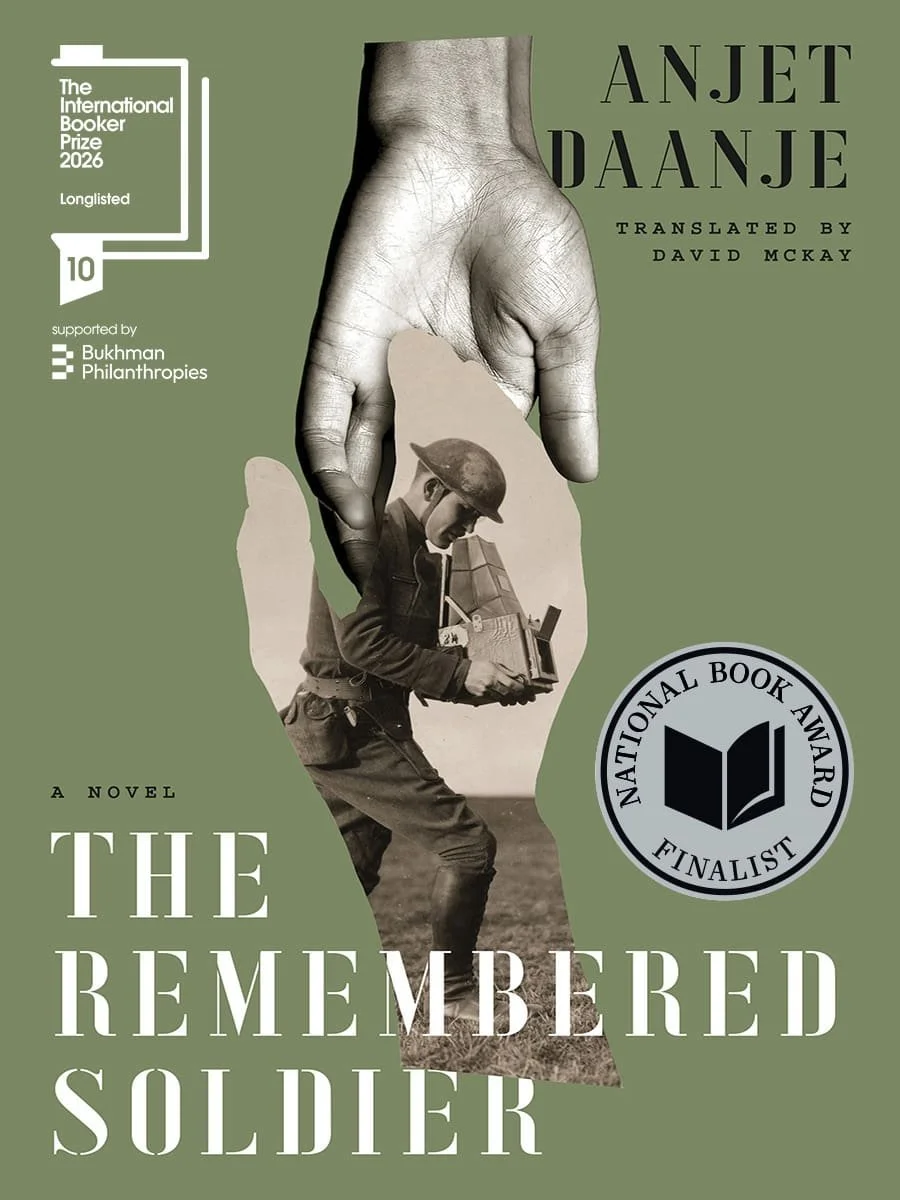
The story unfolds gradually, like the layers of an onion. Julienne runs a photography studio, and she teaches (or reminds) Amand how to take and develop portraits. Often the subjects are war widows, posing (bizarrely) along with Amand in his uniform, against the background of a battlefield, as if this would somehow restore the lives or honor of their lost men. Meanwhile, the marital connection between Amand and Julienne ebbs and flows like a powerful emotional tide.
If there’s a flaw in the novel’s structure, it’s a trivial one: certain minor characters seem marginal and almost irrelevant. There’s a single exception, where one of those minor characters comes to play a significant role. (I’m not one for spoilers). Other minor characters – including relatives of the two protagonists – who one feels ought to be in the story, aren’t. But these are quibbles.
Throughout The Remembered Soldier there is ambiguity as to what exactly Amand and Julienne know, remember, misremember, believe, or pretend to be the case. The truth, and their respective relationships to it, are the stuff of suspense. It amounts to a fascinating meditation on love, war, memory, dissociative mental states, and the horrors we experience and inflict on others due to trauma, confusion, and deceit. In other words: a terrific read.
I revere Tolstoy, having read each of his great novels – War and Peace, and Anna Karenina – twice. The Remembered Soldier doesn’t have their historical sweep, panorama of society, or range of characters. It is deeply focused on its war-ravaged couple. But as great as War and Peace is, Anna is the novel I kept thinking about while reading this contemporary masterpiece. And forgive me for thinking that, in excavating the emotional depths of a deeply troubled and compromised couple, Daanje bores deeper into the psyche than the Russian master. Much deeper, in fact. But since I detest hyperbole, I had better stop there. Give it a try.