
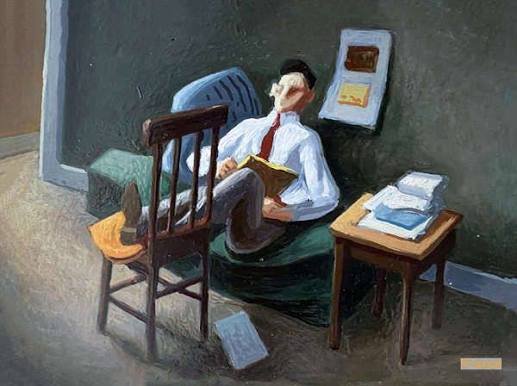
Today – but not just today – I’m at a loss for words. I’m not talking about the several hundred in this post that failed to elude my grasp, but the ones that remain in their hideouts. It’s not the best of news for a writer, but I sometimes have trouble nowadays locating certain words. These elusive words live in my brain but evade my search, hiding in obscure neural pathways, under synaptic rocks or bushes, only to emerge much later – often too late for useful application in, say, a sentence. They shame me (and themselves) by their tardiness.
Pointing a gun at my own head and yelling “Come out, I know you’re in there” won’t help. It’s as if I forgot where I left these words; and it reminds me of the dreams I’ve had recently of looking for my car, having forgotten where I parked it some weeks earlier, and even whether it was in a garage or on the street, when in fact I don’t currently own a car.
This is nothing new or special or tragic. It’s part of the natural process of having grandchildren, and I wish I could blame them for my lexical hiccups and seizures. (I only blame them for being born later than I would have liked; but then, my wife and I were in our mid-thirties when we made their parents). It’s only normal that certain words, having been scooped up by my brain mostly in my teens and twenties, would eventually take to the cerebral hills. And I’m talking about rather ordinary words, not the jejune, tatterdemalion or pulchritudinous ones that we sometimes use to conceal our ignorance. Even scouring the lists of words I’ve amassed over the years – good, useful words, like “rebarbative,” “ennead,” “lobulated,” and “concinnity” that might otherwise be forgotten) is of no use when a particular word that’s not on the list goes AWOL.
The upside, if you can call it that, is that I can usually afford to wait, like a lover at a railway station, for the word I need to arrive. That’s the beauty of being a writer with few strict deadlines. (I wasn’t cut out for daily journalism, but that’s another story for another time). Sometimes they show up, and better late than never. Sometimes not.
Virginia Woolf, in a great essay that I will explore here in the coming months, shows how “Words Fail Me.” Woolf raises a fascinating philosophical issue – in fact it’s one of my personal favorite essays, a North Star for thought about language and meaning. But she was talking about failure of a different kind, inherent in language: how words fail to work when we use them, rather than failing to show up for work. The latter problem is different and purely neurological, which is to say, human.
Why am I sharing this? Not for your sympathy, surely; most people my age have experienced the problem. And it happens as often in conversation as at the keyboard. Maybe you’re one of those people and will feel less alone in your lexical deficit. And maybe there’s another reason. I have thus far resisted putting this blog behind a paywall; but, having just paid $80 for a year’s subscription to another blog, written by an acquaintance whom I barely know, I’m not sure how much longer I can hold out. It comes down to the fact that to maintain my modest writing standards I now have to work that much harder, and wait longer, for the right … the right… um, word. I may have to pass along the cost of that waiting.
If it comes to that, I’m sure you’ll understand. I would never risk losing any of you due to mere greed. And I’m not hoping to elicit comments such as “Please charge me – I’ll pay anything to keep reading “Inside the Liberal Arts.” (Though come to think of it…). But at some point, I may need some compensation for the added work of locating locutions.
I’m not particularly worried about my writing. I have no intention at this point of spending years producing more short, dense books. I’m happy to focus on this blog, some essays, and the occasional snatches of what’s politely called “free verse.” Waiting for words to come isn’t death, but literary constipation: not a pain, but a bore. And a few bucks might be an excellent laxative. (As they say at The New Yorker magazine: Block that metaphor!)
This seemingly personal cri de coeur (French words tend to arrive on time) has everything to do with the liberal arts, because everything I write does. I just can’t find the words to explain what exactly I mean by that. I trust you to fill in the blanks, and for that you will always have my gratitude. In a word: thanks.